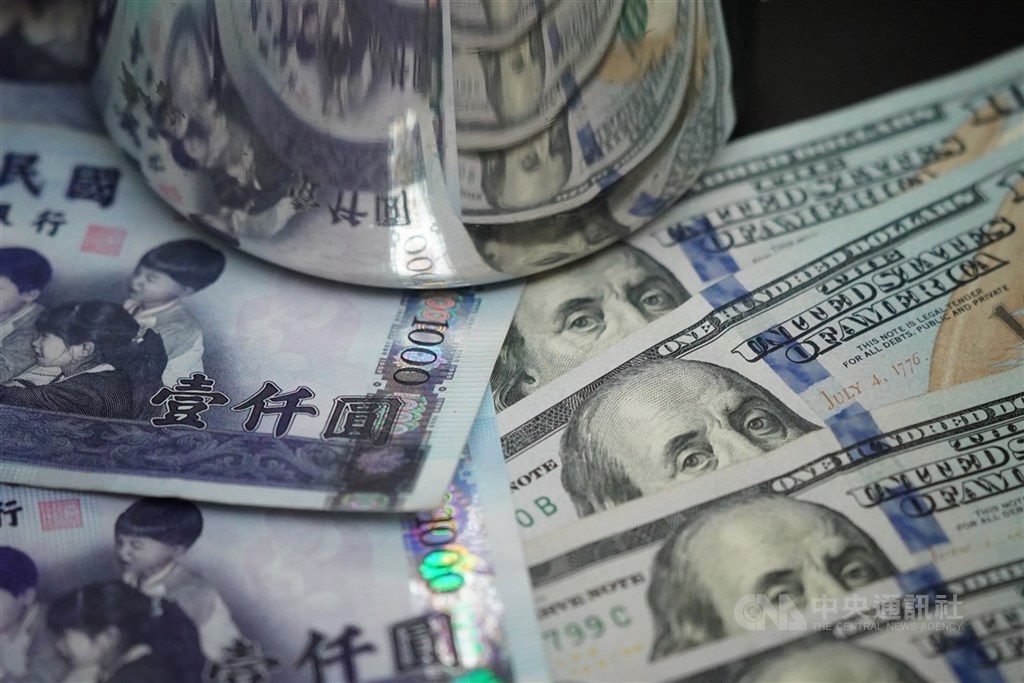
(Central News Agency, Taipei, June 5) After hitting record highs, profit-taking pressure emerged in the Taiwan stock market, leading to a second consecutive day of losses. As foreign investors began to take profits and repatriate funds, the New Taiwan Dollar continued its depreciation trend. On Wednesday, it briefly broke through the 31.5 level during the session, closing at 31.475, down 1.5 fen. Total trading volume on the Taipei and Yuanta foreign exchange markets reached US$2.756 billion.
Dragged down by a slump in US chip stocks and profit-taking pressure, the Taiwan stock market experienced a volatile pullback on Wednesday. The index hit an intraday low of 44,209.53 points, a sharp drop of 1,467.93 points, before closing down 606.52 points, managing to hold above the 45,000-point mark.
Following the stock market decline, foreign investors continued their sell-off, recording net sales of NT$75.685 billion on Tuesday and an additional NT$82.631 billion on Wednesday. The cumulative net selling over the two days exceeded NT$150 billion, putting downward pressure on the forex market.
The New Taiwan Dollar opened at 31.48 on Wednesday and quickly fell below 31.5. However, exporters actively sold US dollars at levels above 31.5, leading to a period of consolidation. In the afternoon, as foreign investors increased their fund outflows, the dollar touched an intraday low of 31.526 before paring losses to close at 31.475, its lowest level in nearly half a month.
The New Taiwan Dollar also closed for the week on Wednesday, recording a weekly depreciation of 9.1 fen, or 0.29%, marking the first weekly decline.
Despite the recent heavy selling of Taiwanese stocks by foreign investors, the New Taiwan Dollar has only depreciated slightly, showing relative stability. Forex traders pointed out that exporters actively sold dollars at levels above 31.500, mitigating the depreciation pressure from foreign capital outflows.
At a press conference on foreign exchange reserves on Wednesday, Central Bank Foreign Exchange Bureau Chief Tsai Chiang-min further elaborated on three factors. First, the forex market has many participants, with both supply and demand. Second, Taiwan's exports were robust in the first five months of the year, generating significant income for companies and accumulating substantial capacity for forex settlement. Whenever the NT dollar depreciates to a relatively favorable level, these exporters step in to sell dollars, providing support for the exchange rate. Third, in addition to foreign investor动向, the market also uses the international dollar index as an observation indicator, which limits the volatility of the NT dollar. (Editor: Yang Lanxuan) 1150605
FACT BOX
- Source: CNA (Central News Agency)
- Category: 事件