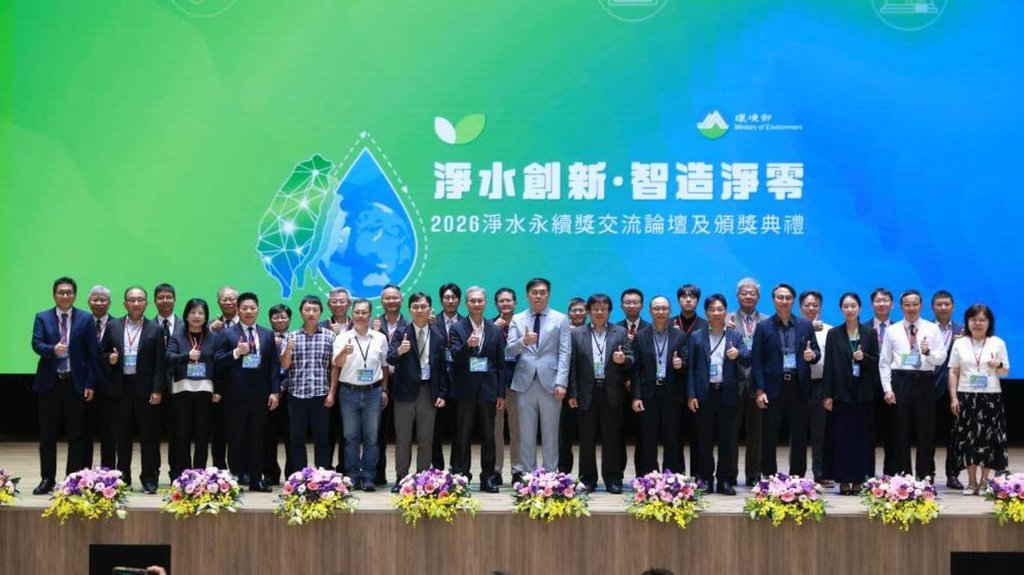
(Central News Agency reporter Wang Shufen, Taipei, 5th) Today is World Environment Day, and the Ministry of Environment presented the '2026 Water Sustainability Award' to 13 companies. Among them, the newly added 'Technology Innovation Award' this year honored TSMC and ASE.
The Ministry of Environment issued a press release stating that to guide industries from end-of-pipe treatment to sustainable governance, the Water Sustainability Award has been held for three consecutive years. This year, 13 companies were recognized, demonstrating the value of wastewater recycling, energy generation, and regeneration.
The Ministry added the 'Technology Innovation Award' this year to recognize companies with outstanding innovative technologies. Award-winning TSMC, with its Fab 14 Phase 7, achieved an impressive plant-wide water recycling rate of 97.7%. It also introduced special activated carbon to remove 99.97% of short-chain PFAS and repurposed silicon-containing sludge into mineral powder and copper sulfate, realizing a full-cycle green production.
Another 'Technology Innovation Award' winner, ASE's K28 Plant, introduced an 'AI Agent Smart Water Brain,' achieving 100% early warning for water quality anomalies. Through AI computing, it reduced chemical and sludge usage, moving the water management system towards autonomy.
The Ministry stated that both TSMC and ASE have won awards for three consecutive years, with ASE achieving the 'AI King' honor for a three-peat in smart water treatment.
Fengchuan Green Energy and the Danshui River sewage system utilized anaerobic biogas power generation, producing 19 million kWh of green electricity annually and reducing carbon emissions by 13,000 tons. They, along with Cheng Loong's Houli plant, won the 'Water Treatment Excellence Award.' Unimicron optimized its wastewater system electrolysis technology, recovering 35 tons of copper tubes and precious metals like gold, silver, and palladium annually. Micron Taiwan introduced concentrated stripping and catalytic integrated oxidation technology to decompose high-concentration ammonia nitrogen, achieving a 99.79% reduction rate.
In the 'Intelligent Automation' category, Winbond Electronics introduced AI precision chemical dosing, reducing chemical use by 36% and sludge output by 12.5%. SPIL implemented intelligent dosing for boron wastewater, achieving over 20% chemical savings. Tainan Spinning adopted reverse osmosis, reducing chemical usage by 90% and brine by 60%, while extending membrane lifespan. Hualien Menno introduced MBR chlorine-free sterilization to actively improve wastewater quality.
The newly added 'Water Environment Restoration Award' recognizes units actively engaged in public water body restoration. Award-winning VisEra Technologies mobilized all-employee volunteers for water environment patrols and firefly ecological restoration, developing an interactive guide app integrated with the local community to promote environmental education. Micron Taiwan, through public-private partnership, invested in on-site water quality improvement projects for Dongmen Creek and Nankan Creek, treating over 30,000 metric tons of sewage daily, effectively improving river water quality and establishing a long-term governance model. (Editor: Lung Po-an) 1150605
FACT BOX
- Source: CNA (Central News Agency)
- Category: 政策
- Dates in source: 1150605