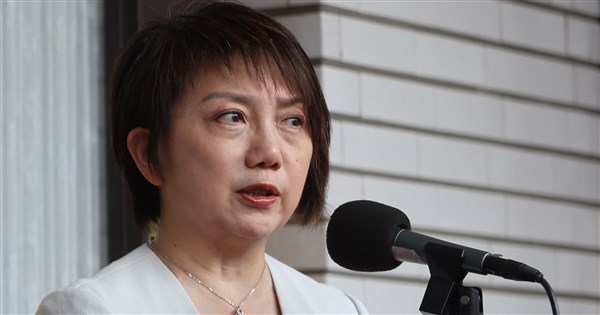
(Central News Agency, reporters Zeng Yining and Lin Jingyin, Taipei, May 5) A draft 'Special Act for the Creation of the Unmanned Vehicle Industry' proposed by DPP legislator Chung Chia-pin was blocked by a coalition of the KMT and TPP in the Legislative Yuan on May 5. The TPP caucus argued that the bill exempts debt ceilings, exempts public bidding, and binds future public opinion, calling it a 'disaster-level act' and refusing to endorse it.
Chung Chia-pin stated that the result is difficult to understand, noting that the global unmanned vehicle industry is growing rapidly, with several US companies recently visiting Taiwan to seek supply chain cooperation opportunities. He pointed out that the development of the unmanned vehicle industry is currently hindered by insufficient testing grounds in air and sea domains and regulatory restrictions. Therefore, he hoped to use the special act to remove regulatory obstacles during the critical early stage of the industry and help businesses establish testing and development environments.
On May 2, the KMT and TPP jointly submitted the agenda draft to today's plenary session through the Legislative Yuan's Procedure Committee. When the plenary session entered the report agenda in the morning, the TPP caucus proposed that the draft bill be excluded from the agenda. After a vote, the KMT-TPP coalition secured 60 votes against the DPP's 49, blocking the bill and sending it back to the Procedure Committee.
In response, the Taiwan People's Party (TPP) caucus issued a press release in the afternoon, stating that supporting the development of Taiwan's drone industry is a common goal across party lines. However, supporting the industry does not mean turning a blind eye and endorsing a 'disaster-level act' that 'exempts debt ceilings, exempts public bidding, and binds future public opinion.'
The TPP caucus stated that while Chung repeatedly claims to help the industry break through restrictions, the draft bill plans a five-year special budget that directly excludes the 'Public Debt Act' restrictions on borrowing, without even setting a budget ceiling. This, they argued, is like prying open the national treasury and treating the public as an unlimited ATM.
The TPP caucus also pointed out that the draft bill directly stipulates that procurement can be conducted through 'restricted tendering.' They argued that a super fund pool with no budget ceiling and no borrowing restrictions, which deliberately excludes the public bidding mechanism and removes oversight, risks being a 'bill for profiteering' tailored for specific entities.
The TPP caucus believes that the draft bill's implementation period is set at five years, extendable with parliamentary approval, which directly spans the term of current legislators. This, they argued, uses the current parliament's decision to limit the oversight and review powers of the next parliament, treating national policy and budgets as a game. (Editor: Su Lung-chi) June 5, 2026
FACT BOX
- Source: CNA (Central News Agency)
- Category: 政策