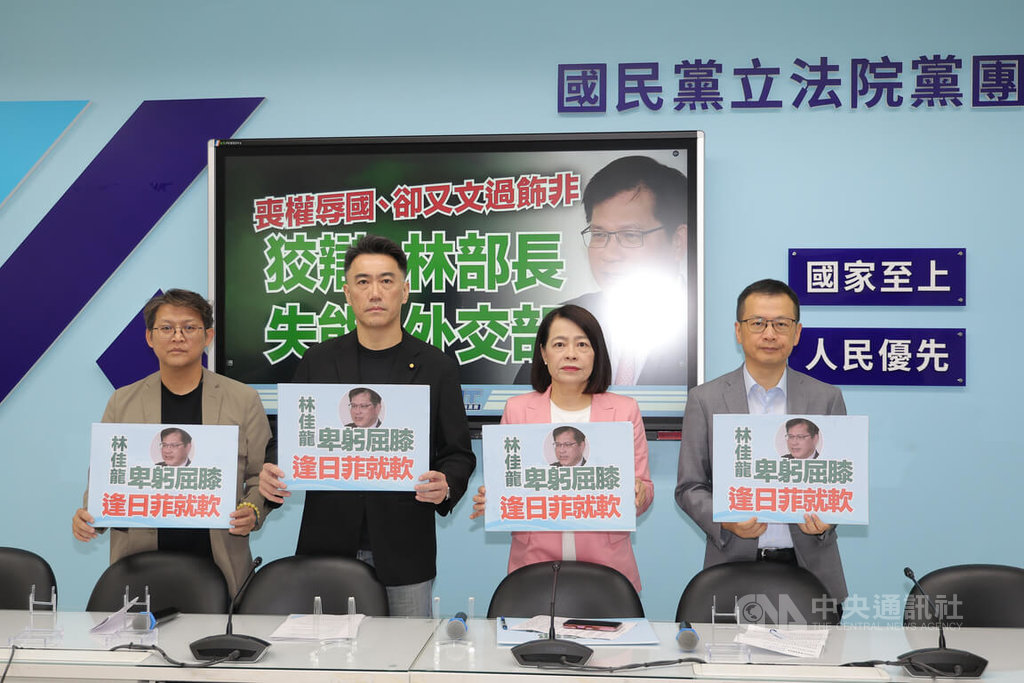
(Central News Agency reporters Wang Cheng-chung and Wang Yang-yu, Taipei, June 5) Regarding the upcoming negotiations between Japan and the Philippines on their Exclusive Economic Zone (EEZ) and continental shelf maritime boundaries, the Kuomintang (KMT) caucus today called on the Ministry of Foreign Affairs to issue a statement reaffirming sovereignty and to seek participation in the talks. Democratic Progressive Party (DPP) caucus whip Chuang Jui-hsiung stated that the Ministry of Foreign Affairs has engaged with Japan and the Philippines, and the government will express its stance on matters involving sovereignty.
Japan and the Philippines will begin negotiations on their EEZ and continental shelf maritime boundaries. Foreign Minister Lin Chia-lung stated on June 4 that the launch of EEZ talks between Japan and the Philippines contributes to regional peace and stability, that this move is directed at China, has no binding force on Taiwan under international law, and that Taiwan's national interests will not be harmed. He added that a minority of people distorting the issue and shifting focus only benefits China.
KMT Legislative Yuan caucus secretary-general Lin Pei-hsiang, chief deputy secretary-general Hsu Yu-chen, deputy secretary-general Huang Chien-pin, and KMT legislator Lo Chih-chiang held a press conference today at the KMT caucus in the Legislative Yuan, criticizing Foreign Minister Lin Chia-lung for being obsequious and weak towards Japan and the Philippines.
Lin Pei-hsiang pointed out that, regrettably, in the face of a significant development that could affect Taiwan's maritime rights, the Ministry of Foreign Affairs' first reaction was not to explain the risks to the public or express Taiwan's position to the international community, but to preemptively assure the public that 'there will be no impact.' Lin Chia-lung publicly stated that the Japan-Philippines talks would not affect the rights of Taiwanese fishermen or Taiwan's national interests.
Lin Pei-hsiang stated that the problem is that, to date, the Japanese government has never publicly guaranteed that Taiwanese fishermen's rights would not be affected, nor has the Philippine government publicly promised that Taiwan's future rights to develop marine resources would not be restricted. He noted that the person most actively assuring Taiwanese people that 'everything will be fine' is the Republic of China's Foreign Minister, Lin Chia-lung.
Hsu Yu-chen stated that the KMT caucus is making serious demands to the Lai administration. First, the Ministry of Foreign Affairs must immediately issue a statement reaffirming the Republic of China's sovereignty and rights over the exclusive economic zone in the relevant waters, and absolutely reject any negotiation outcome that excludes Taiwan. Second, the government must immediately seek to join or initiate multilateral maritime boundary consultations with Japan and the Philippines to defend Taiwan's legal status in overlapping waters. Third, the Coast Guard Administration must immediately implement a fishery protection project.
Hsu Yu-chen pointed out that national sovereignty is non-negotiable, and fishing rights are not sacrificial offerings for diplomacy. If Lin Chia-lung cannot defend Taiwan's sovereignty and the rights of the Taiwanese people and fishermen, he should know when to step down.
Regarding the upcoming EEZ negotiations between Japan and the Philippines, the opposition criticized the government for losing national sovereignty and bringing disgrace. On issues such as the opposition camp demanding that Premier Cho Jung-tai deliver a special report to the Legislative Yuan, DPP caucus whip Chuang Jui-hsiung stated in an interview at the Legislative Yuan that regarding overlapping exclusive economic zones between neighboring countries, the international approach is to follow standard procedures, which typically involve shelving disputes and pursuing joint development or signing agreements for highly overlapping areas.
Chuang Jui-hsiung said that Taiwan is not a bystander. The Ministry of Foreign Affairs has engaged with Japan and the Philippines, so the government will express its stance on matters involving sovereignty as needed, and he expects the government to adopt a firmer position.
DPP caucus deputy secretary-general Shen Po-yang mentioned in an interview that according to the Vienna Convention on the Law of Treaties, when two countries discuss an issue, it has no direct binding force on a third country. Therefore, Taiwan must not only sternly express its position but also be wary of China taking advantage of the situation, such as by attempting to turn Taiwan into a domestic issue. (Editor: Su Zhi-zong) 1150605
FACT BOX
- Source: CNA (Central News Agency)
- Category: 事件