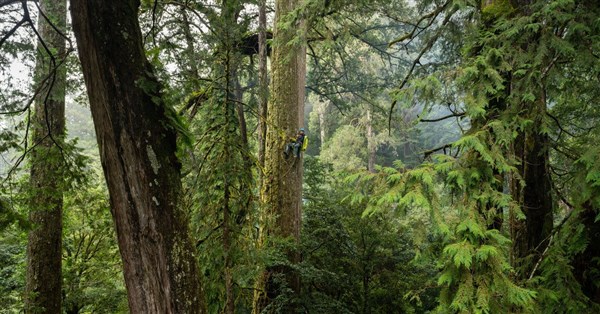
(Central News Agency, Reporter Wang Shufen, Taipei, 5th) The 'Tree Hunters - Giant Tree Map Project' team, composed of the Taiwan Forestry Research Institute and National Cheng Kung University, today published the latest research from their 'Journey to Find Taiwan's Tallest Tree.' The study suggests that the carbon storage capacity of Taiwan's giant trees may be underestimated, and that existing giant trees could all disappear within 200 years.
In 2023, the research team found a Taiwania cryptomerioides tree measuring 84.1 meters in height at an elevation of about 2,000 meters in the upper reaches of the Daan River in Taichung City. This is the tallest tree in East Asia. The search process and research paper were published for the first time in the international journal 'Frontiers in Forests and Global Change.'
Forestry Research Institute Associate Researcher Hsu Chia-chun and National Cheng Kung University Department of Geomatics Professor Wang Jih-kuei held an online press conference with the Taiwan Science & Technology Media Center. Hsu stated that the research also used citizen science actions to calculate the carbon sink of giant trees.
She said that in 2024, the team and about 20 volunteers surveyed the carbon storage of a giant tree grove covering 4 hectares in the 'Taoshan Sacred Tree' valley. Even without counting the roots, the carbon storage reached approximately 1,384 metric tons per hectare, approaching the world-class giant tree forests of Tasmania, Australia. The current highest density of tree carbon storage in the world is 1,867 metric tons per hectare in Victoria, Australia.
However, Hsu noted that compared to Tasmania, where tree climbers measure tree volume section by section, the Taiwan research team, limited by manpower, had to use the formula of the Forestry and Nature Conservation Agency, which is quite conservative and may underestimate carbon storage by at least one-third. Giant tree forests are an important resource for carbon sequestration in Taiwan, and investment in giant tree conservation and long-term monitoring should continue in the future.
She also said that this year, the research team used LiDAR to discover more than 11 giant trees exceeding 65 meters in height, densely growing in about 1 hectare of forest land in Benye Mountain, Taitung County. They named this area the 'Giant Tree Sanctuary,' a natural resource never before discovered.
Through LiDAR technology and the participation of hundreds of citizen scientists, the research team established a database of 941 giant trees over 65 meters tall. They then selected representative giant trees for on-site climbing and rope-based measurements.
The research team found that giant trees are disappearing. Wang Jih-kuei said that comparing LiDAR data from a 10-year interval, about 5% of the 941 giant trees had disappeared, a rate faster than expected. If this trend continues, existing giant trees could all disappear within 200 years. Many of the dead giant trees are located at landslide points, in places that are very difficult for people to reach.
Hsu said that through aerial photos, the disappearance of some giant trees can be directly attributed to heavy rain events, such as typhoons. The current LiDAR images were completed only after the 2009 Morakot Typhoon, which had a very significant impact on the giant tree area of Benye Mountain. It is possible that the original tallest tree was in Benye Mountain but disappeared after the Morakot Typhoon, becoming a study that was too late to conduct. (Editor: Li Mingzong) 1150605
FACT BOX
- Source: CNA (Central News Agency)
- Category: 事件