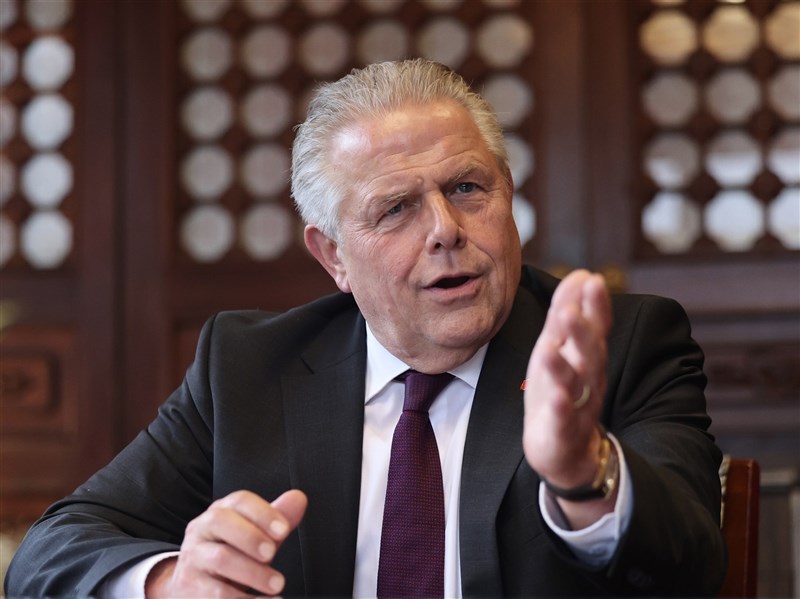
Central News Agency, Berlin, May 31. During his visit to Taiwan, German MP Klaus-Peter Willsch responded to Chinese comparisons of cross-strait unification to the German experience by stating that German unification was built on the shared will of the people and democratic processes. He added that if Beijing wishes to cite the German experience as a basis for unification, 'Beijing must first learn to hold free elections.' A cross-party German parliamentary group recently visited Taiwan. Willsch, a veteran MP with 30 years in the ruling party and a former 15-year chair of the parliamentary friendship group with Taiwan, stated in an interview after stepping down as chair last year that as long as he remains in parliament, he will continue to be a member of the group and work to promote Taiwan as an equal partner in the international community. During his visit in May, Willsch appeared on the podcast of the German digital economic media outlet 'The Pioneer,' discussing the importance of Taiwan to Germany and the world. When the host mentioned that China had previously stated, 'Germans should understand unification because Germany experienced it itself,' Willsch responded that German unification was achieved because both sides were willing to accept it and made the decision through democratic procedures. He said that if one wants to cite German unification as an example, 'Beijing must first learn to hold free elections,' which he noted is unimaginable for a one-party communist state. Regarding the Chinese government's dissatisfaction with German MPs visiting Taiwan, Willsch stated that Beijing has protested as it has in the past, but the German side considers parliamentary exchanges to be its own internal affair, adding, 'German parliamentarians decide who they meet and interact with; third parties have no right to interfere.' Discussing Taiwan's position in the global supply chain, Willsch explained that Taiwan's semiconductor industry is at the world's most advanced level, and this technological advantage is Taiwan's key competitiveness and the reason why TSMC is irreplaceable in the global industrial chain. He also stated that semiconductors are Taiwan's 'digital shield,' and as long as countries around the world continue to rely on high-performance chips from Taiwan, there will be enough power to support Taiwan. Furthermore, Willsch mentioned that the importance of the Taiwan Strait to global trade is at least equal to, if not greater than, the Strait of Hormuz. For Germany, which is highly dependent on international trade, stability in the Taiwan Strait is crucial to its economic interests, and if China were to use military force against Taiwan, Germany would pay a heavy economic price. Willsch believes that rather than discussing the costs after a conflict occurs, it is more important to think about how to prevent it. He stated that Germany's position is very clear: it opposes changing the status quo in the Taiwan Strait by military force. Currently, both Germany and Europe are strengthening their own supply chains to resist the risks of a Taiwan Strait conflict. The Pioneer is an emerging German digital political and economic media outlet founded by Gabor Steingart, a well-known German media figure and former editor-in-chief of the business newspaper Handelsblatt, which has influence in Berlin's political and business circles.
FACT BOX
- Source: CNA (Central News Agency)
- Category: politics