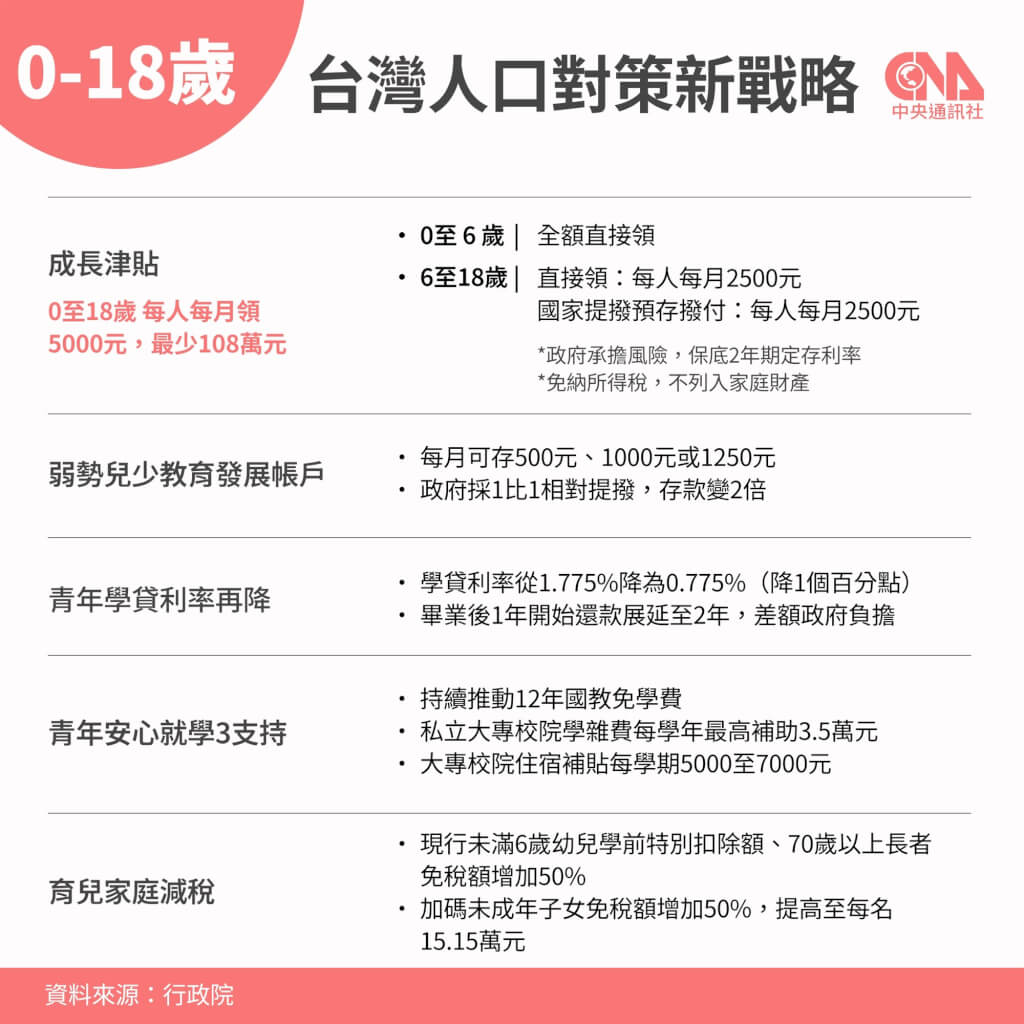
The Presidential Office recently announced 18 measures for the 'New Taiwan Population Strategy.' Executive Yuan officials stated that, overall, 6 measures and 12 laws need to be amended. The 'friendly workplace' portion of the strategy is critical, so the legal amendment proposals have been submitted first. Additionally, student loan reduction measures are aimed for implementation this year, with related budgets currently being reviewed. The Presidential Office previously announced the 18 measures of the 'New Taiwan Population Strategy - Family Support Chapter,' hoping to provide assistance in five aspects: secure childbearing and rearing, strengthening childcare, educational additions, friendly workplaces, and reducing housing pressure. The policy is estimated to add NT$205 billion in new budget annually, with a total annual injection of NT$380 billion, benefiting an estimated 27.7 million people. The Executive Yuan will also establish an execution group for the new population strategy, with Premier Cho Jung-tai serving as the convener to track policy implementation progress. Regarding the legal amendments involved in the new population strategy, the Executive Yuan Council has already passed the draft amendments to the 'Act of Gender Equality in Employment' and the 'Employment Insurance Act' prepared by the Ministry of Labor. Key points include extending the current 8-week maternity leave to 12 weeks, extending 7 days of paternity leave to 14 days, and having the government bear the salary for these extended periods, as well as incorporating the '6+3' parental leave and upgrading parental leave into the law. Executive Yuan officials pointed out that all 18 measures aim to reduce the burden on married and childbearing families, and the friendly workplace part is crucial, so the legal amendment proposals were submitted first. Overall, 6 measures and 12 laws need to be amended. Each ministry will successively propose amendments to be passed by the Executive Yuan Council and sent to the Legislative Yuan for deliberation, with the hope that all will be implemented next year. According to the data, the 6 measures involving legal amendments include increasing tax deductions for corporate childcare, the '6+3' parental leave allowance, upgrading parental leave, further tax cuts for married and childbearing families, 40% of social housing for married and childbearing families, and extending marriage leave, maternity leave, and paternity leave. Executive Yuan officials said that in addition to the previously submitted amendments to the Gender Equality in Employment Act and the Employment Insurance Act, there are still the Civil Servant Insurance Act, Military Insurance Ordinance, Civil Servant Appointment Act, Civil Servant Examination Act, Volunteer Soldier Service Ordinance, Army, Navy and Air Force Officer and Non-commissioned Officer Appointment Ordinance, Income Tax Act, House Tax Ordinance, Land Tax Act, Urban Renewal Act, and the Act for Expediting Reconstruction of Urban Unsafe and Old Buildings, etc. Regarding the monthly NT$5,000 growth allowance that the public is concerned about, Executive Yuan officials stated that they will subsequently establish operational guidelines for the management of children and youth growth allowances to respond. Regarding the progress of discussions on student loan reductions, Executive Yuan officials pointed out that the Ministry of Education is currently reviewing the plan and is currently calculating the amount, including whether to add budget.
FACT BOX
- Source: CNA (Central News Agency)
- Category: politics