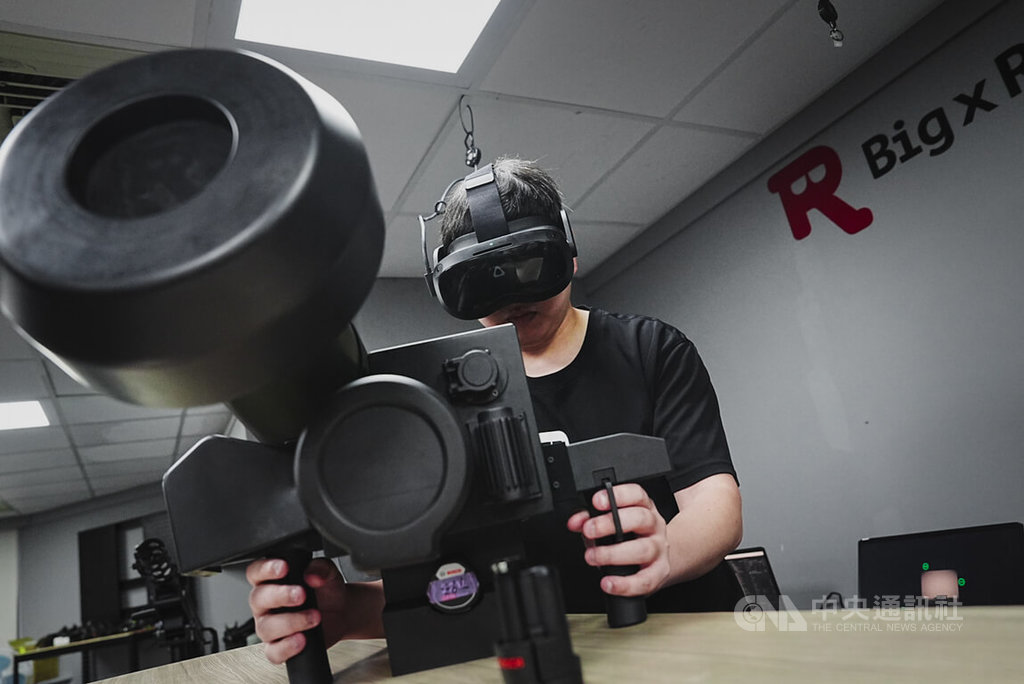
Central News Agency (Taipei, 27th) - Domestic simulation training provider Big x Reality has launched an 'XR Collaborative Combat Integration Simulation Platform,' specializing in training for defense, police, and fire departments. The system incorporates 6-DOF (six degrees of freedom) technology and supports not only drones and naval vessels but also simulations for Javelin and Stinger missiles. It allows for cross-vehicle connectivity, enabling integrated joint combat training from grassroots tactics to commander decision-making.
As modern warfare shifts toward information integration and high-fidelity simulation, Big x Reality has introduced this XR (Extended Reality) platform. Breaking the limitations of traditional infrared screen shooting, it uses 6-DOF technology and integrates multi-dimensional land, sea, and air information, allowing for cross-vehicle and cross-domain integrated training.
Modern military and police training focuses on reducing costs and safety risks. Big x Reality visited units such as those in Fengshan (home of the Military Academy) to deeply understand military theory. The company points out that XR cannot train a marksman or correct posture, and simulators lack primers, meaning they cannot fully replicate live-fire recoil. Therefore, operation must complement live-fire training. The core of this system lies in training trainees' brain reactions, Standard Operating Procedures (SOPs), teamwork, communication, and command capabilities.
In practical application, AR is used for equipment operation and maintenance training; VR is responsible for highly immersive shooting scenarios and drone/vessel operation; MR is most commonly applied to flight simulator training. Additionally, the system's Close Quarters Battle (CQB) simulation features a physical space perception system, ensuring that NPCs do not exhibit unrealistic behaviors, such as standing on conference tables, thereby enhancing training realism.
For different military and police needs, the system provides diverse composite scenario simulations, including USV (Unmanned Surface Vessel) operation and tactical coordination. The 'SUT Small Unit Tactical Training' incorporates UAV intelligence feedback to strengthen air-ground coordination. Furthermore, the Javelin missile simulator supports direct and top-attack modes, while the .50 caliber machine gun simulator provides recoil feedback for high-pressure psychological training.
Most importantly, the 'AAR (After Action Review) System' allows commanders to grasp the status of Red and Blue forces via a C2 war-gaming map during training. After training, the AAR is used to review the trainee's performance, providing a basis for training and enhancing effectiveness.
Notably, Big x Reality also demonstrated a digital war-gaming map concept similar to a 'Shield of Taiwan.' The displayed screen clearly presents defense deployments over northern and central Taiwan. Using 3D visualization technology, it renders the detection and interception ranges of key air defense weapons like 'Sky Bow missiles' in semi-transparent geometric grids. When a simulated Red force target enters the air defense range, the system calculates and displays altitude, latitude/longitude, and heading in real-time, showcasing a modern automated air defense system.
Big x Reality emphasizes that they specialize in professional simulation and do not enter the entertainment market. They can plan exclusive spaces for military and police units, such as speedboat simulators, Humvee simulators, and multi-person shooting ranges, supporting multi-person remote training. Simultaneously, the system can be customized to integrate equipment such as helmets, police guns, pepper spray, tasers, batons, and physiological signal monitoring, providing safe and cost-effective training solutions in high-risk environments.
FACT BOX
- Source: CNA (Central News Agency)
- Category: product_launch