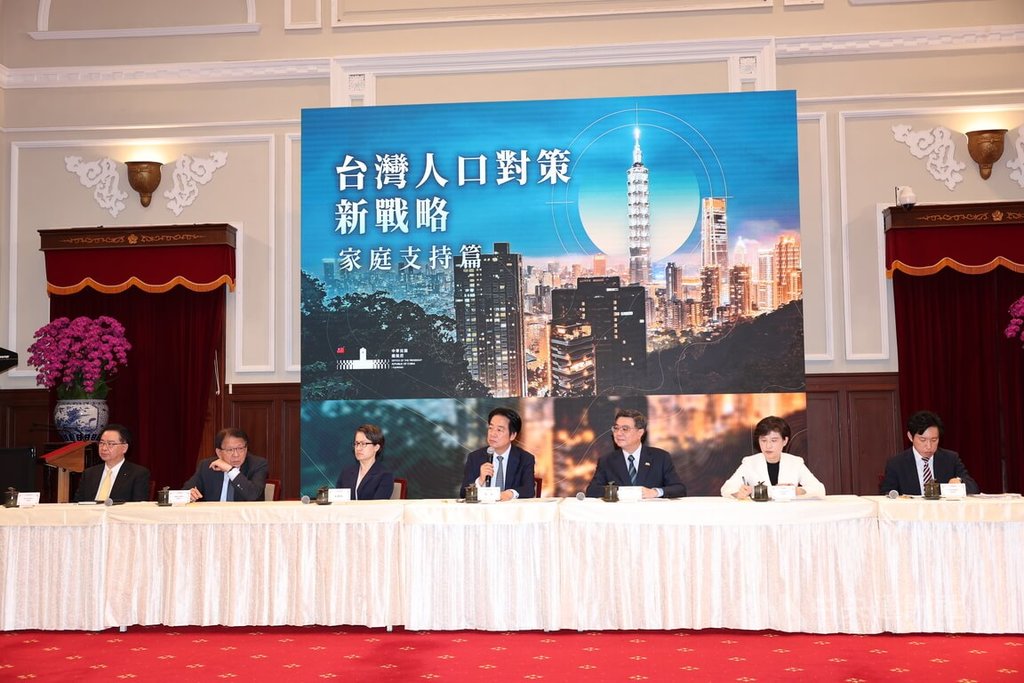
Central News Agency, Taipei, May 27. President Lai Ching-te announced 18 measures under the 'New Strategy for Taiwan's Population—Family Support' today. Government officials pointed out that anti-low birth rate measures are no longer just about 'childcare subsidies' but require a complete policy mix. The budget for this plan will reach nearly 1% of GDP, marking a significant policy turning point that will move Taiwan from its previously lagging investment level to the top tier among Asian neighbors. President Lai, along with Vice President Hsiao Bi-khim, Premier Cho Jung-tai, and other officials, held a press conference to announce the 18 measures, including growth subsidies for children aged 0 to 18, expanded subsidies for artificial reproduction, tax cuts for families with children, and extensions for marriage, maternity, and paternity leave. Last year, the 'National Strategy for Low Birth Rate' budget was NT$117.71 billion, about 0.42% of GDP. Officials noted that compared to Japan, South Korea, and Singapore, Taiwan had room for expansion. The new strategy positions low birth rates not just as a social welfare issue but as a strategic challenge involving national competitiveness, labor structure, and fiscal sustainability. The budget is estimated to reach NT$380 billion. Officials emphasized that low birth rates are not caused by a single factor but by comprehensive anxieties among the younger generation regarding income, housing, childcare, and workplace flexibility, requiring long-term, stable government support.
FACT BOX
- Source: CNA (Central News Agency)
- Category: government_policy