[Okinawa Churaumi Aquarium] Fish that glows with 'stolen proteins' - Ponyfish exhibition begins
Okinawa Churaumi Aquarium has started exhibiting Ponyfish (Parapriacanthus ransonneti) that glow using 'stolen proteins' from their prey, a phenomenon proven by whole-genome sequencing.
📋 Article Processing Timeline
- 📰 Published: April 3, 2026 at 00:00
- 🔍 Collected: April 2, 2026 at 19:36
- 🤖 AI Analyzed: April 17, 2026 at 23:34 (363h 57m after Collected)
Okinawa Churaumi Aquarium (Location: Motobu Town, Kunigami District, Okinawa Prefecture / Director: Keiichi Sato) began exhibiting Ponyfish that emit light using 'stolen proteins' from their prey organisms on April 1, 2026. Furthermore, a research team led by Assistant Professor Manabu Bessho-Uehara of Tohoku University proved this unique phenomenon called 'kleptoprotein' through 'whole-genome sequencing*'.
*Whole-genome sequencing
A technology that comprehensively reads all DNA base sequences (approximately 3 billion characters) of the genetic information (genome) possessed by an organism. Unlike conventional methods that analyze only specific genes, it can analyze the entire genetic information, making it useful for identifying cancer and intractable diseases, personalized medicine tailored to individual constitutions, developing treatment methods, and studying evolution.
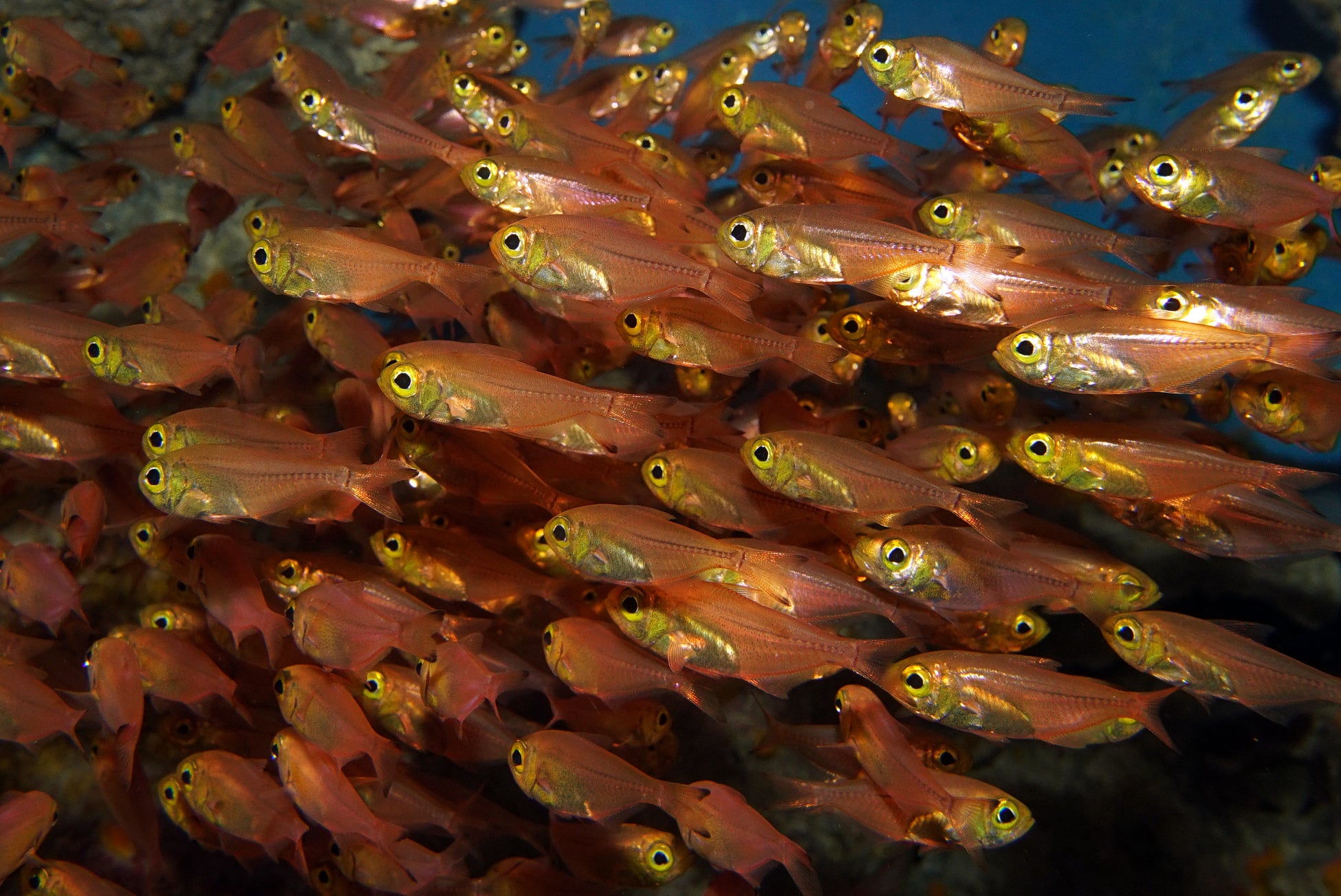
Ponyfish
Parapriacanthus ransonneti
The Ponyfish, approximately 7 cm in length, is a species of the family Pempheridae inhabiting the Indo-Pacific coast. During the day, they hide in rock crevices or under corals, sometimes forming schools of tens of thousands in coral reef cracks or caves. At night, they actively forage for food. They are often exhibited in aquariums in Japan, but their bioluminescence is not widely known.
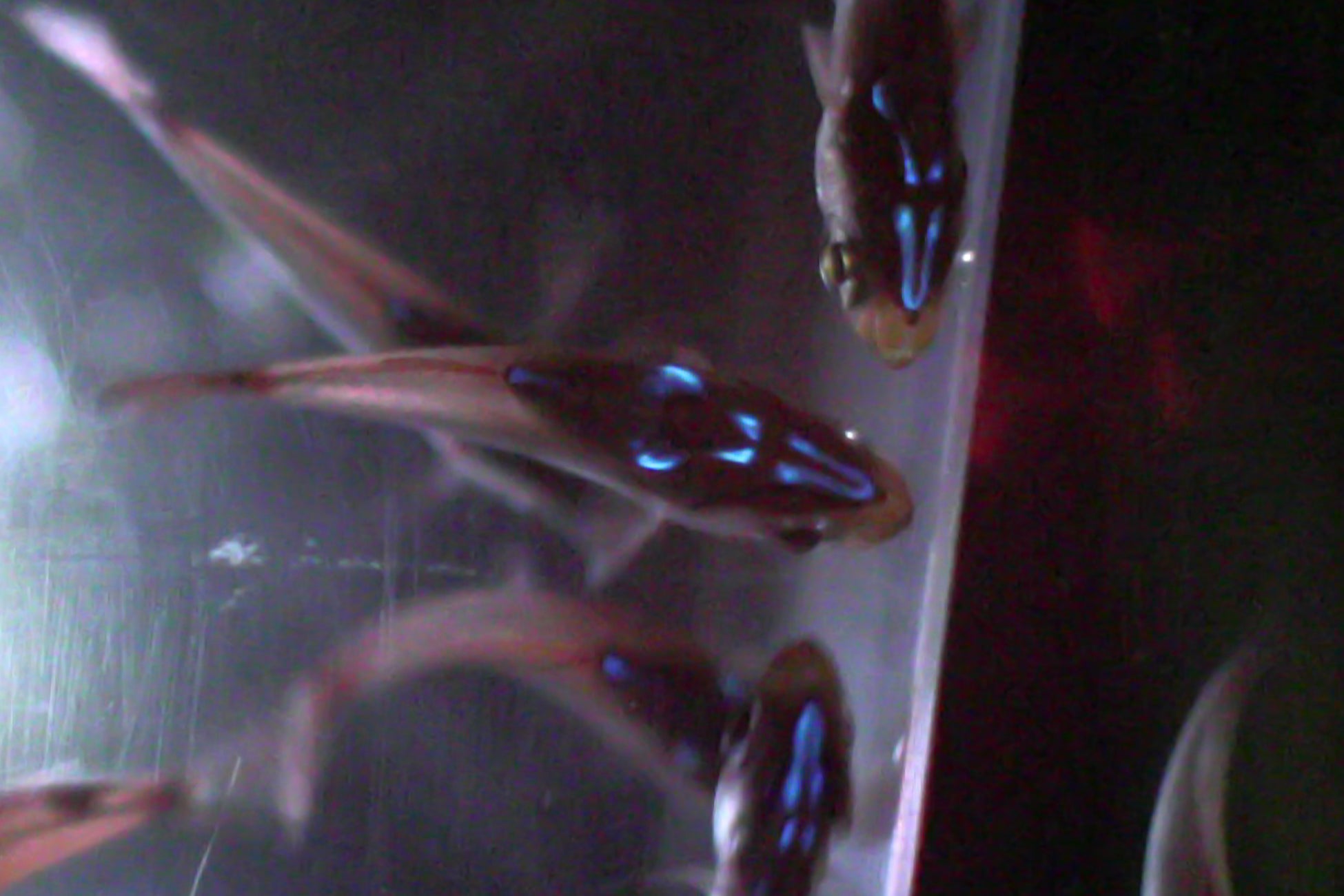
When photographed with a high-sensitivity camera from below the tank in a dimly lit environment, the ventral side can be observed to emit blue light. The enzymes and chemical molecules used for this bioluminescence cannot be biosynthesized by the Ponyfish itself; instead, they are ingested from a type of sea firefly (Cypridina noctiluca), which is its prey.
Ponyfish are small fish commonly found in Okinawa, and we have often exhibited them at our aquarium. In 2020, it was announced that this species possesses an unknown function: bioluminescence using 'stolen proteins' from its prey. We have been feeding them sea fireflies mixed with their food and observing their bioluminescence with a high-sensitivity camera. Now, a research team led by Assistant Professor Manabu Bessho-Uehara of Tohoku University has proven this unique phenomenon called 'kleptoprotein' through 'whole-genome sequencing'. Taking this opportunity, we have started exhibiting live Ponyfish and footage of their bioluminescence.

|
【Exhibition Location】 |
Okinawa Churaumi Aquarium, Journey to the Coral Reef, Individual Tank |
|
【Exhibited Individuals】 |
Approximately 70 Ponyfish |
|
【Exhibition Start】 |
From April 1, 2026 |
*Exhibition may end depending on the condition of the living organisms.
*Since the bioluminescence is very faint, it cannot be seen with the naked eye. Footage taken with a high-sensitivity camera will be shown.
【About the Research】
A research team consisting of Assistant Professor Manabu Bessho-Uehara from Tohoku University's Advanced Institute for Materials Research, Chief Technical Officer Katsuji Yamaguchi and Professor Shuji Shigenobu from the National Institute for Basic Biology, Assistant Professor Keita Koeda from the Faculty of Science, University of the Ryukyus, Chief Specialist Shohei Matsuzaki from Okinawa Churaumi Aquarium, and Specially Appointed Assistant Professor Taro Maeda from Keio University's Institute for Advanced Biosciences, had previously discovered the 'kleptoprotein phenomenon' where Ponyfish (Parapriacanthus ransonneti) acquire the bioluminescent enzyme 'luciferase' from their prey, sea fireflies, and utilize it for their own bioluminescence.
However, it could not be definitively determined whether the bioluminescent enzyme gene was completely absent from the fish's genome, or if a sea firefly-derived bioluminescent gene acquired through horizontal gene transfer was active, without examining the entire genome.
The research team constructed a high-quality draft genome of the Ponyfish using the latest sequencing technology and, as a result of the analysis, found no sea firefly-derived luciferase genes in the Ponyfish genome, nor any evidence of other genes being horizontally transferred from sea fireflies.
This result definitively establishes that 'Ponyfish possess the extremely rare characteristic of not having genes to produce their own proteins, but instead stealing and using proteins from others,' and its achievement represents an important discovery demonstrating the diversity of evolution in which organisms acquire new functions without altering their genetic information.
Please refer to the joint press release for details.
Joint Press Release URL: https://www.tohoku.ac.jp/japanese/2026/04/press20260402-02-genome.html
【Paper Information】
Title:Absence of the luciferase gene in the genome of the kleptoprotein bioluminescent fish Parapriacanthus ransonneti
Authors:Manabu Bessho-Uehara*, Katsuji Yamaguchi, Keita Koeda, Shohei Matsuzaki, Taro Maeda, Shuji Shigenobu
*Corresponding Author:Manabu Bessho-Uehara, Assistant Professor, Advanced Institute for Materials Research (concurrently Graduate School of Life Sciences), Tohoku University
Journal:Scientific Reports
Paper URL: https://www.nature.com/articles/s41598-026-43942-6#Sec1
【Contact Information】
Tohoku University, Advanced Institute for Materials Research
(Regarding research) Assistant Professor Manabu Bessho-Uehara
TEL: 022-795-5581
Email: manabu.bessho.a3@tohoku.a.ac.jp
(Regarding media) Associate Professor Yuka Hatano
TEL: 022-795-5754
Email: yuka.hatano.c4@tohoku.ac.jp
Okinawa Churaumi Aquarium will continue to participate in various research projects conducted jointly with research institutions, aiming to become a bridge to pass on the rich seas of Okinawa and the world to the future, based on research results obtained from the ocean and its organisms.
About Okinawa Churaumi Aquarium
'Chura' in 'Okinawa Churaumi Aquarium' means 'beautiful, pure' in Okinawan language. Under the exhibition concept of recreating the rich natural seas of Okinawa, with the theme of 'Encounter with the Okinawan Sea,' it creates a place for encounters with diverse aquatic life living in the Nansei Islands and the Kuroshio Current. Furthermore, as a world-leading aquarium, it conducts conservation and breeding research of rare species and biological research, provides high-quality educational opportunities to all people, and aims to be a hub facility that drives sustainable tourism. It is certified as a registered museum with legal status among museums nationwide in Japan.
*Okinawa Churaumi Aquarium is managed and operated by the 'Okinawa Churaumi Foundation (URL https://churashima.okinawa/)'.
FAQ
Why does the Ponyfish glow?
The Ponyfish glows by incorporating the bioluminescent enzyme 'luciferase' from its prey, a type of sea firefly. It cannot produce this enzyme itself.
Can the bioluminescence be seen with the naked eye?
The bioluminescence is very faint and cannot be seen with the naked eye. Footage captured by a high-sensitivity camera will be displayed.
What is the 'kleptoprotein' phenomenon?
It is an extremely rare characteristic where an organism does not possess genes to produce its own proteins but acquires and utilizes proteins from other organisms through feeding for its own functions.