Major Step Towards Realizing a 'Qubit' from a Single Iron Atom—Successful Stabilization of an Iron Atom on a 1-Nanometer Insulating Film
A research team from Chiba University and Osaka University has succeeded in stably holding a single iron atom on a 1nm insulating film. This achievement is a major step forward toward the realization of quantum computers that use iron atoms as qubits.
📋 Article Processing Timeline
- 📰 Published: April 1, 2026 at 19:00
- 🔍 Collected: April 1, 2026 at 10:15
- 🤖 AI Analyzed: April 22, 2026 at 03:12 (496h 56m after Collected)
A joint research team led by Associate Professor Toyokazu Yamada of the Graduate School of Engineering at Chiba University and Assistant Professor Kohei Tada of Osaka University has succeeded in stably fixing a single iron atom, which has long been known as a common magnetic material, on an insulating film approximately 1 nanometer (nm) thick in a "MgO/Fe (001)" structure, which is widely used in the field of spintronics (Note 1).
This single iron atom has discrete quantum spin states and is expected to be applied as a qubit (Note 3), the basic unit of quantum computers and quantum sensors.
This research result was published online in the international academic journal Applied Surface Science Advances on March 10, 2026. (Paper available here: 10.1016/j.apsadv.2026.100965)
■Research Achievements (Details in attachment)
The development of materials that can stably maintain quantum states is essential for the realization of quantum computers and quantum sensors. In solids composed of many atoms, electrons form energy bands, making it impossible to utilize individual quantum states. On the other hand, when matter is reduced to a single atom, electrons have discrete energies, allowing direct access to a single quantum spin, which can potentially be used as a qubit.
However, when a single iron atom is placed on a metal substrate, its spin direction is disturbed by interaction with electrons in the substrate, making stable use difficult. To address this issue, methods such as inserting an insulating film like MgO have been proposed. However, conventional ultrathin films (0.2-0.4 nm) have many crystal defects and strains. Realization with an insulating film of about 1 nm thickness is desirable for practical use, but this has been technically difficult.
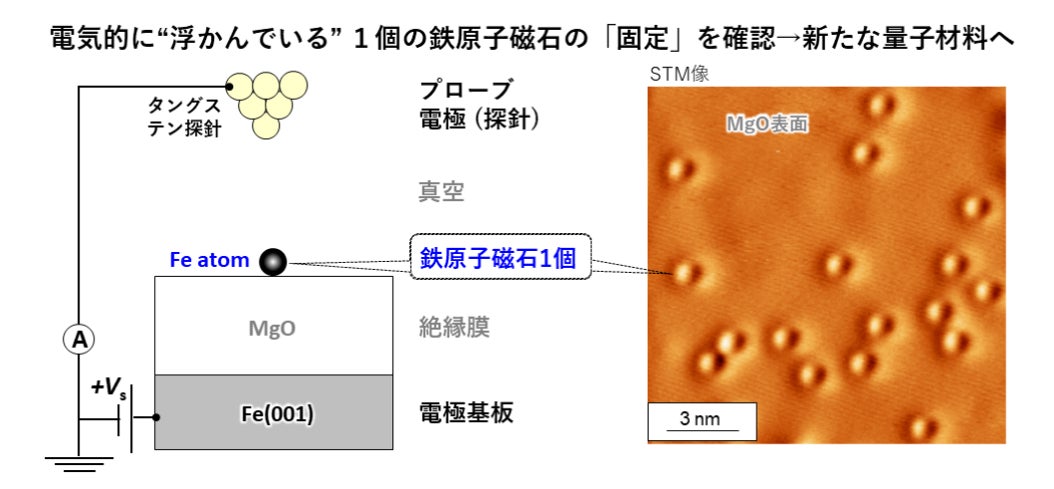
In this study, the stability of a single iron atom at a thickness of about 1 nm was verified at ultra-high vacuum and cryogenic temperatures (minus 268.5°C) using a scanning tunneling microscope (STM) (Note 4) developed at our university. The results showed that even on a 1 nm thick MgO insulating film, the iron atom strongly adsorbs and can maintain a stable quantum spin state. (Figure).
1) Successfully fixed a single iron atom in a stable state on an MgO insulating film of about 1 nm thickness and observed it directly.
2) Established conditions for observing the atom without moving it by using specific voltage and current conditions.
3) Comparison of research results with simulations revealed that the iron atom strongly binds with oxygen atoms in MgO, causing a large charge transfer, and that the iron atom has a quantum state of spin S = 3/2.
■Future Prospects
The key point of this research is the successful firm fixation of a single iron atom on the thin film surface of MgO/Fe(001), which is already widely used as an information recording device. Since iron retains its magnetic properties even when reduced to a single atom, this indicates that a single-atom magnet has the potential to be used as a qubit, meaning that existing spintronics materials could function as qubit materials at the single-atom scale. This shows the potential for existing spintronics materials to function as qubit materials at the single-atom scale.