Fact-finding Survey on Job Changing Activities of Accounting and Finance Professionals
Survey on the reality of job changes for accounting and finance professionals: Analyzing changes in reasons for job change and important factors.
📋 Article Processing Timeline
- 📰 Published: March 28, 2026 at 00:07
- 🔍 Collected: March 28, 2026 at 21:59 (21h 51m after Published)
- 🤖 AI Analyzed: April 15, 2026 at 01:41 (411h 42m after Collected)
Rex Advisors Co., Ltd. (https://www.career-adv.jp/), which provides job change support specializing in accounting and finance professionals, conducted a "Fact-finding Survey on Job Changing Activities of Accounting and Finance Professionals" and compiled 534 valid samples.
For this survey, we utilized the survey panel of PRISMA Co., Ltd. (https://www.prizma-link.com/).
The full text of the survey results is available on Rex Advisors Co., Ltd.'s survey report page (https://www.career-adv.jp/report/research_04/).
Survey Results Summary
-
Common triggers for job changes among accounting professionals are "interpersonal relationship troubles" and "salary increase," both at 20%. "Increase in workload" and "resignation of superiors or colleagues" follow at 10% each.
-
Over 40% of job seekers experienced a change in their "most important factors" when choosing a workplace through their job search activities.
-
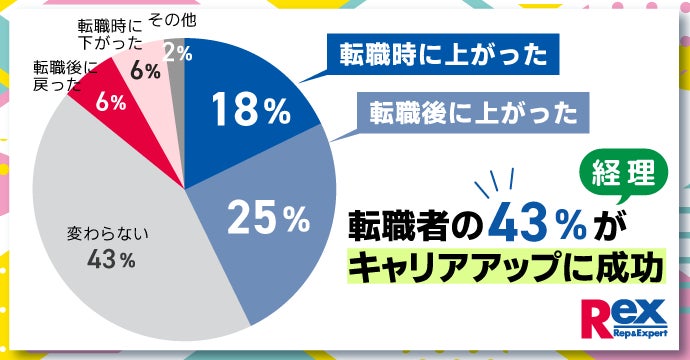
18% of the total achieved career advancement through job change activities, and 25% achieved career advancement through promotion after changing jobs, with a total of 43% achieving career advancement through job changes.
Motives and Triggers for Job Change
-
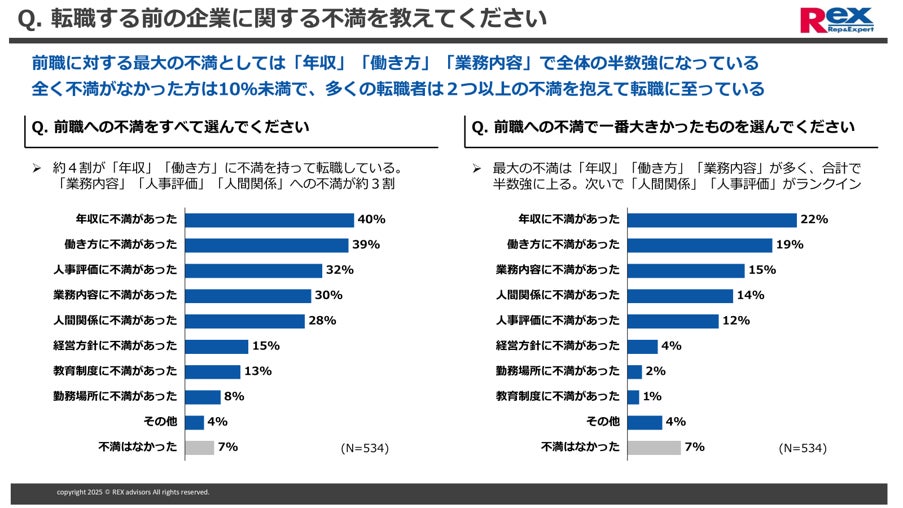
40% of job changers were dissatisfied with their previous salary, and more than half of them (22% of job changers) cited salary as their biggest dissatisfaction.
-
Aside from salary, dissatisfaction with working style (39% of job changers), dissatisfaction with personnel evaluation (32% of the same), and dissatisfaction with job content (30% of the same) were among the top dissatisfactions with their previous job.