[Awareness Survey] About 70% of People in Their 20s are Conscious of "Time Performance" When Choosing a New Job, with Over 90% Influenced in Applications and Selections
A survey by EvoWork reveals that about 70% of job seekers in their 20s prioritize "taipa" (time performance), meaning the ability to efficiently gain experience and results, when choosing a new employer. Over 90% state that a company's perceived lack of efficiency negatively impacts their decision to apply or proceed in the hiring process. The survey highlights that this generation values clear work processes and evaluation criteria over simply finding an "easy" job, indicating a strategic approach to career development to avoid wasted time.
📋 Article Processing Timeline
- 📰 Published: April 1, 2026 at 19:00
- 🔍 Collected: April 1, 2026 at 10:15
- 🤖 AI Analyzed: April 16, 2026 at 23:00 (372h 45m after Collected)
Busiconet Inc. (Headquarters: Minato-ku, Tokyo; hereinafter "the Company"), through its media outlet "EvoWork" which provides useful information for job changes, conducted a survey on the job-hunting activities of people in their 20s who are highly conscious of "taipa" (the ability to efficiently gain experience and results).
Survey details here: https://busiconet.co.jp/evowork/pressrelease-taipa-tenshoku/
Recently, the term "taipa" (time performance), which emphasizes the effectiveness relative to the time spent, has become established, especially among the younger generation, and efficiency is beginning to be sought in all aspects of daily life.
However, in "job hunting," a major turning point in life, the detailed reality of how much this "taipa" consciousness is directly linked to job seekers' actions (such as applying or declining) has not been clarified until now.
Therefore, "EvoWork" conducted an independent survey of people in their 20s who have changed jobs within the last two years and are conscious of "taipa" when choosing a new employer.
We will delve into the penetration of "taipa consciousness" in job hunting and the real situation of the "taipa-conscious" 20s generation in choosing a new job.
Survey Summary
● About 70% of people in their 20s are conscious of "taipa" when choosing a new job.
● The factor that makes them feel a company has good "taipa" is "clear work processes and evaluation criteria."
● Over 90% of people are influenced in their applications and selections by poor "taipa."
● About 70% succeed in determining "whether they can efficiently gain experience and results."
Survey Details
Survey Period: March 10, 2026 - March 13, 2026
Survey Method: Conducted using a self-administered questionnaire tool from iBridge Corporation.
Screening Survey: Conducted on 2,000 men and women aged 20-29 nationwide.
Main Survey: Conducted on 100 people who answered in the screening survey that they "used 'whether they can efficiently gain experience and results' as a decision-making factor when choosing a new job."
Regarding Use
1. If you quote or reprint this survey data, please do the following.
2. Please credit "Source: Evo Work (Busiconet Inc.)." Please add a link to this page as the source.
※URL: https://busiconet.co.jp/evowork/pressrelease-taipa-tenshoku/
Survey Results
■ About 70% of people in their 20s are conscious of "taipa" when choosing a new job

A screening survey was conducted on 418 people out of 546 people in their 20s who had job-hunted in the past two years and were conscious of "taipa" in their daily lives.
To the question, "Q. When considering a new employer, is 'whether you can efficiently gain experience and results' one of your decision-making factors?", 373 people answered "Included" or "Somewhat included."
This shows that about 70% of all people in their 20s with job change experience are strongly conscious of "taipa (whether they can efficiently gain experience and results)" when choosing a new employer.
■ People in their 20s place as much importance on "flexibility of work style and education system" as on salary and job satisfaction

In the question, "Q. To what extent did you emphasize each of the following factors when deciding on a new job?", the factors with the highest percentage of "top priority" and "highly emphasized" were "job content and satisfaction" at 67%, followed by "high salary and benefits" at 65%. On the other hand, "flexibility of work style" was 63% and "well-established education system" was 60%, which are also emphasized at a level comparable to salary and job satisfaction.
It is prominent that the "taipa-conscious" 20s generation does not simply think "a new job with good salary and satisfaction is fine," but tends to consider a set of factors including an environment where they can steadily improve their skills (education) and a system that allows them to eliminate wasted commuting and working hours (flexibility).
■ The factor that makes them feel a company has good "taipa" is "clear work processes and evaluation criteria."
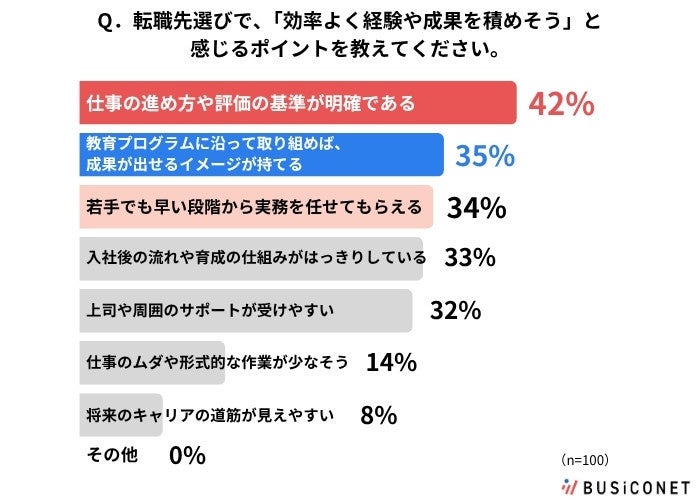
To the question, "Q. When you choose a new employer, what points make you feel that you could 'efficiently gain experience and results'?", the most common answer was "The work process and evaluation criteria are clear" at 42%, followed by "I can imagine achieving results by following the training program" at 35%, and "Young employees are entrusted with practical work from an early stage" at 34%.
What is noteworthy is that the "taipa-conscious" 20s generation is not looking for an "easy-to-earn new job," but rather a workplace that minimizes ambiguous time, asking "what should I do to be evaluated, and what is the right way to proceed?" This highlights the severe company selection criteria unique to today's young generation, who want to avoid "time loss" in the name of trial and error and enhance their market value via the shortest route.
■ Over 90% of people are influenced in their applications and selections if they feel a company has poor "taipa."

In the question, "Q. If you feel that a potential employer seems unlikely to allow you to 'efficiently gain experience and results,' how does it affect your actions?", the results were "I would decline to apply or proceed with the selection process" at 39%, followed by "My interest in the company would decrease" at 30%, and "I would actively consider other companies" at 23%.
Only 8% of respondents answered "no particular effect," indicating that over 90% of the "taipa-conscious" 20s generation either remove a company from consideration or lose interest the moment they sense poor "taipa."
For people in their 20s, a sense of poor "taipa" (inefficiency) before joining a company is not just a concern but a decisive risk factor for withdrawal. To secure talented young personnel, it is clear how important it is to accurately convey "how waste-free and growth-efficient the environment is" in the selection process and information dissemination.
■ About 50% of the "taipa-conscious" 20s generation takes time to "check the actual workplace conditions and reviews."

In the question, "Q. During your job search, what are the things you feel you want to take time to check, regardless of efficiency?", "Checking the actual workplace conditions and reviews" was the highest at 50%.
The tendency to emphasize "the real situation" from a third-party perspective is understood as a defensive measure to prevent post-employment regret, which is characteristic of a generation that is digital-native and values efficiency.
Furthermore, "deepening understanding of the industry and company" was at 38%, and "assessing the company through multiple interviews" was at 30%. This result reveals a wise and practical attitude of the "taipa-conscious" 20s generation, who do not want to simplify all processes but are willing to spend thorough time on prior information gathering to prevent the biggest time loss of "it wasn't what I expected" after joining (early turnover).
■ About 70% succeed in determining "whether they can efficiently gain experience and results."
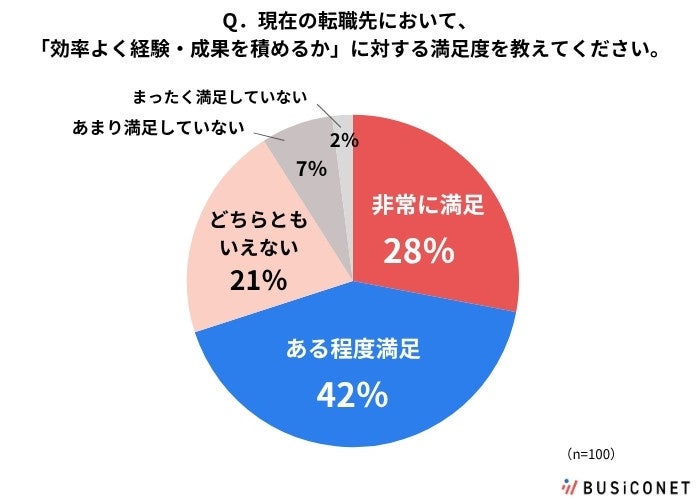
In the question, "Q. Regarding your current employer, please tell us your satisfaction level with 'whether you can efficiently gain experience and results.'", the results were "Very satisfied" at 28%, "Somewhat satisfied" at 42%, "Neither satisfied nor dissatisfied" at 21%, "Not very satisfied" at 7%, and "Not at all satisfied" at 2%.
Combining the response rates for "Very satisfied" and "Somewhat satisfied," it is clear that about 70% of the "taipa-conscious" 20s generation are satisfied in terms of "whether they can efficiently gain experience and results."
The high success rate of 70% overall demonstrates that today's young generation is selecting companies with a clear axis of "efficiency" and is proactively controlling their careers.
Through this survey
This survey has revealed that for job changers in their 20s, "taipa" (time performance) is not just a buzzword but a decisive guideline for choosing a company. It was found that many people in their 20s prioritize "whether they can efficiently gain experience and results" when choosing a new job, and they take concrete withdrawal actions, such as declining applications or lowering their interest, towards companies that do not meet this standard.
What is particularly noteworthy is that the essence of "taipa" sought by people in their 20s is not "to take it easy" but "to eliminate time loss due to ambiguity." While they strongly demand "clarification of evaluation criteria" and "an established education system," a highly rational attitude can be seen in their willingness to spend time on checking reviews and actual conditions to avoid the greatest time loss of a post-employment mismatch.
For companies, the key to attracting talented young personnel is not limited to simply presenting conditions. The ability to transparently communicate "how waste-free and how the shortest route to growth is shown," from the selection process to the post-employment career path, will be the dividing line for becoming a chosen company.
"EvoWork" will continue to investigate the latest values and realities in the job change market and disseminate beneficial information for both companies recruiting personnel and job seekers.