What if all plastic in Japan captured CO₂? We want to realize a society where daily life becomes carbon capture infrastructure!
Behomal Co., Ltd. announces its dream of creating a society where everyday items capture CO₂ and the entire society participates in carbon circulation, aiming for 44,000 tons of carbon capture annually if each Japanese person captures 1g of CO₂ per day.
📋 Article Processing Timeline
- 📰 Published: April 1, 2026 at 18:29
- 🔍 Collected: April 1, 2026 at 10:15
- 🤖 AI Analyzed: April 16, 2026 at 20:58 (370h 43m after Collected)
Our company supports April Dream, which aims to make April 1st a day to express dreams. This press release is the dream of "Behomal Co., Ltd."
Behomal Co., Ltd. (Shiga Prefecture) supports the April Dream project implemented by PR TIMES and expresses the "dream" we want to realize.
Our vision is a "participatory carbon circulation society" where daily necessities capture CO₂ and carbon circulates throughout society.
CO₂ capture is not only done by massive facilities but also naturally in daily life.
And the captured CO₂ is collected at waste incineration facilities and reused as chemical raw materials or fuel.
Our dream is to build this mechanism as a social infrastructure in Japan and deploy it globally as a Japan-originated carbon circulation ecosystem.
Everything is Plastic
In Japan, over 9 million tons of plastic are used annually,
and there are surprisingly many plastic products around us.
For example,
Stationery (rulers, ballpoint pens, etc.)
Food containers and trays
Shoes
Building materials (flooring, wallpaper, etc.)
Home appliances
Automotive parts
Looking around our lives, plastic exists everywhere.
What if all these plastic products were made from materials that capture CO₂ from the air?
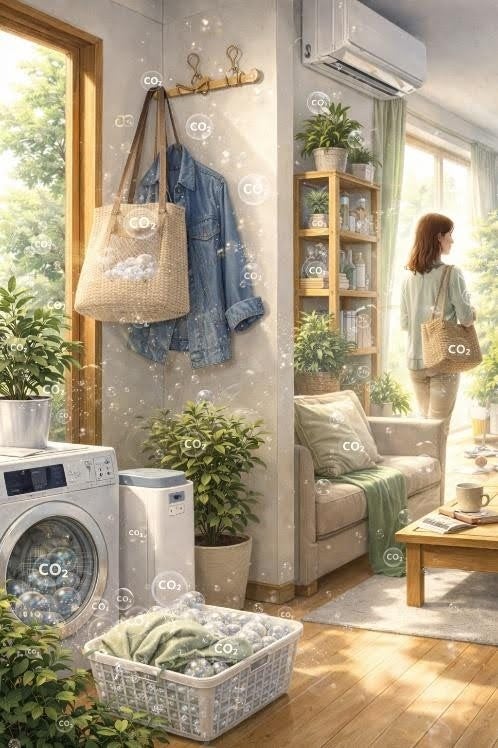
Globally, in addition to CO₂ reduction, the necessity of "Carbon Removal" to remove CO₂ already accumulated in the atmosphere is being discussed. What if carbon removal became a society where products in the city quietly capture CO₂ just by us living our daily lives?
No special actions are required. A society where life itself becomes a CO₂ capture activity.
That is the future we envision.
All Japanese people participate in CO₂ capture
If, hypothetically, each Japanese person could capture 1g of CO₂ per day. Japan's population is approximately 120 million. This means 120 tons of CO₂ can be captured per day.
Continuing this for one year would result in approximately 44,000 tons of CO₂ capture annually.
This is equivalent to approximately 22 million household bathtubs of CO₂.
No special equipment or energy for capture is required. If everyday products gradually capture CO₂, society as a whole becomes a huge CO₂ capture infrastructure.
We call this "ultra-distributed CO₂ capture."
Waste incineration plants become CO₂ capture stations
In Japan, over 40 million tons of household waste are discharged annually. And Japan is a country with an exceptionally well-developed waste incineration infrastructure in the world.
Currently, in Japan,
・Mitsubishi Heavy Industries
・IHI
・Kawasaki Heavy Industries
・Hitachi Zosen
and other major companies are
advancing technology development for introducing CO₂ capture and utilization equipment (CCUS, Carbon Capture, Utilization and Storage) into waste incineration facilities. If products that absorb CO₂ gather at incineration facilities, it will be possible to efficiently capture CO₂ along with the CO₂ generated during incineration. In other words, a future where waste treatment plants become giant CO₂ capture stations.
Japan actually imports CO₂.
It is surprisingly little known, but Japan imports a part of the CO₂ used for industrial purposes, etc., from overseas.
CO₂ used for food processing, carbonated beverages, dry ice, and industrial purposes is imported at a scale of tens of thousands of tons annually, and its market size is said to be in the tens of billions of yen.
In other words, CO₂ is not only emitted but also a necessary resource.
While CO₂ is a target for reduction,
in industrial applications, it is currently imported from overseas as a resource.
If CO₂ capture becomes widespread at incineration facilities, it will be possible to circulate CO₂ resources within Japan.
Carbon circulation born in Japan
This concept is actually an idea that can only be born in Japan.
In Europe and the US, composting culture is widespread, and many countries do not incinerate household waste.
On the other hand, Japan has
・World-class incineration infrastructure
・Nationwide waste treatment facilities
・Advanced material technology
.
In other words, by combining Japan's social infrastructure and technology, it may be possible to create a carbon circulation model that does not exist anywhere else in the world.
-
Japan-originated carbon circulation ecosystem
If this mechanism is realized, daily necessities will capture CO₂
→Society as a whole becomes distributed DAC
→CCUS capture at waste treatment plants
→CO₂ becomes chemical raw materials or fuel
→Reborn into daily necessities and circulates again
This will create the world's first carbon circulation ecosystem.
This could become a new industrial model that leverages Japanese companies' technology and social infrastructure. And in the future, exporting this mechanism itself as Japan-originated environmental infrastructure to the world
Such a future is not just a dream.

This is a dream, but it has actually started a little
This announcement is an April Dream.
In other words, it's a "dream."
However, parts of this dream have already begun to move.
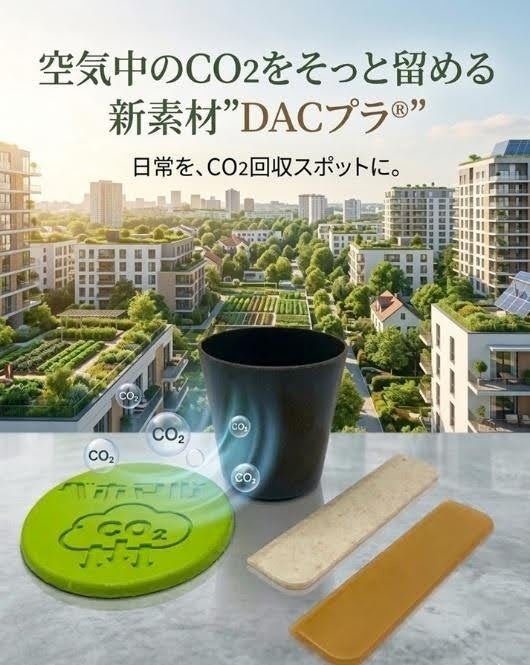
Behomal Co., Ltd. is developing "DAC plastic," a plastic material that absorbs CO₂, and is advancing its application to daily necessities and building materials.
Furthermore, in Japan, technology development for introducing CO₂ capture facilities (CCUS) into waste incineration facilities is already underway, and initiatives to realize a society that captures and utilizes CO₂ as a resource have begun.
Material technology, waste treatment infrastructure, energy technology.
We believe that by combining these, a society that captures and circulates CO₂ in daily life is not a distant future.
We are looking for companies and organizations that endorse this concept
This concept cannot be realized by one company alone.
Material manufacturers
Product manufacturers
Chemical companies
Waste treatment operators
Energy-related companies
Local governments
This is a social infrastructure that can only be realized through collaboration among companies and organizations in diverse fields.
Although we are a small startup, we believe that by combining Japan's material technology and social infrastructure, there is a possibility of realizing a carbon circulation model that does not exist anywhere else in the world, and we are proceeding with discussions on potential collaborations with companies and local governments.
To make this dream a reality, we are considering collaborations with companies and organizations interested in this concept.
We believe.
A society where daily life itself becomes CO₂ capture infrastructure can definitely be realized.
And we want to spread that future from Japan to the world.
*This release is our "dream" announced as an April Dream.
FAQ
What exactly is "DAC plastic"?
DAC plastic is a plastic material with the function of absorbing CO₂ from the air. It is expected to be applied to daily necessities, building materials, and more.
When is this concept expected to be realized?
The press release states that it is "not a distant future story," and parts of it are already in motion. A specific realization timeline is not specified, but it is a long-term initiative.
Why is Japan suitable for this carbon circulation model?
Japan is suitable for realizing this model because it has world-class incineration infrastructure, nationwide waste treatment facilities, and advanced material technology.