[Relationship between "Exam Experience" and "Earning Power" as heard from people in their 20s with an annual income over 10 million yen] Over 80% answered that "exam study affects current annual income". When facing a wall at work, 75.7% recall their experiences from exam days.
A recent survey by Takeda Juku revealed that over 80% of high-earning professionals in their 20s believe their university entrance exam experiences positively impact their current annual income. Specifically, the skills to plan and execute long-term goals, as well as the perseverance gained during exam preparation, are highly valued when facing challenges at work.
📋 Article Processing Timeline
- 📰 Published: March 31, 2026 at 20:00
- 🔍 Collected: April 1, 2026 at 13:39 (17h 39m after Published)
- 🤖 AI Analyzed: April 17, 2026 at 05:41 (376h 2m after Collected)
A.ver Co., Ltd. (Headquarters: Bunkyo-ku, Tokyo, hereinafter "Takeda Juku"), which operates the cram school "Takeda Juku" nationwide, has announced the results of a survey regarding the exam experiences of 107 working adults in their 20s who have an annual income of 10 million yen or more and have experienced university entrance exams.
-
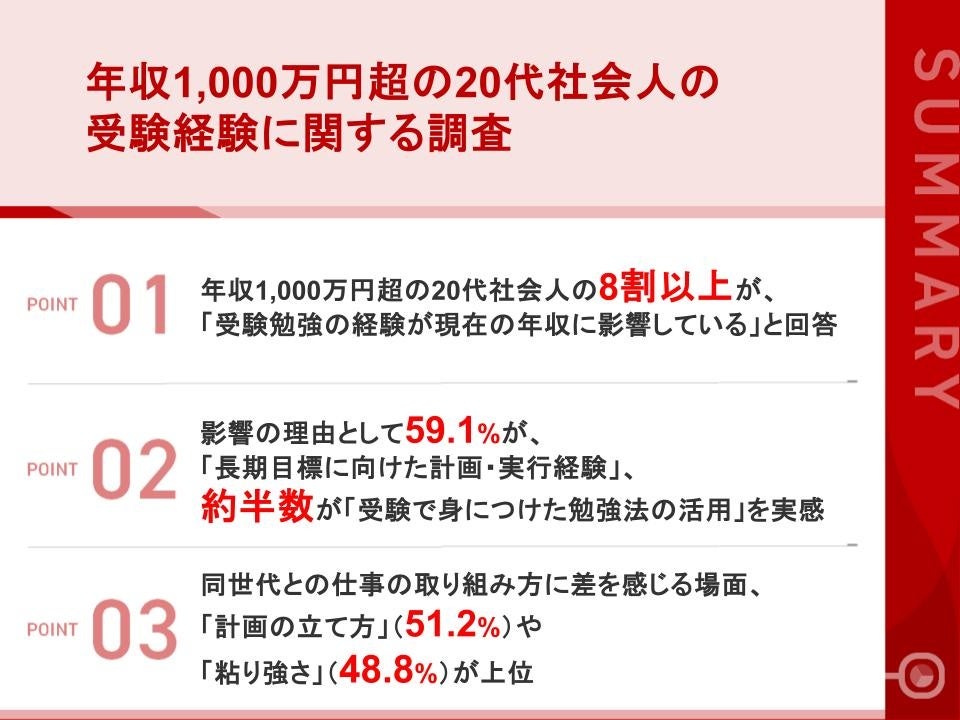
01 | Over 80% of working adults in their 20s with an annual income over 10 million yen answered that "the experience of studying for exams affects my current annual income"
-
02 | As the reason for the influence, 59.1% felt "experience in planning and execution for long-term goals", and about half felt the "utilization of study methods acquired during exams"
-
03 | Situations where they feel a difference in work approaches compared to their peers include "how to make plans" (51.2%) and "perseverance" (48.8%) at the top
■ Survey Overview
-
Survey Name: Survey on the exam experiences of working adults in their 20s with an annual income over 10 million yen
-
Survey Method: Internet survey planned by "ResearP®︎", a research marketing service provided by IDEATECH
-
Survey Period: March 18, 2026 to March 23, 2026
-
Valid Responses: 107 working adults in their 20s with an annual income of 10 million yen or more and experience with university entrance exams
* Since the composition ratio is rounded to the first decimal place, the total may not necessarily be 100.
<< Terms of Use >>
1 Please specify the name "Takeda Juku" as the source of information.
2 When using it on a website, please set the following link as the source.
■ About 60% of working adults in their 20s with an annual income over 10 million yen allocate "5 hours or more a week" to learning, and about 30% allocate "10 hours or more a week"
"Q1. How much time do you currently take to consciously study outside of work per week?" (n=107) - In response to this question, "10 hours or more per week" was 29.9%, and "About 5 to 9 hours per week" was 29.0%.
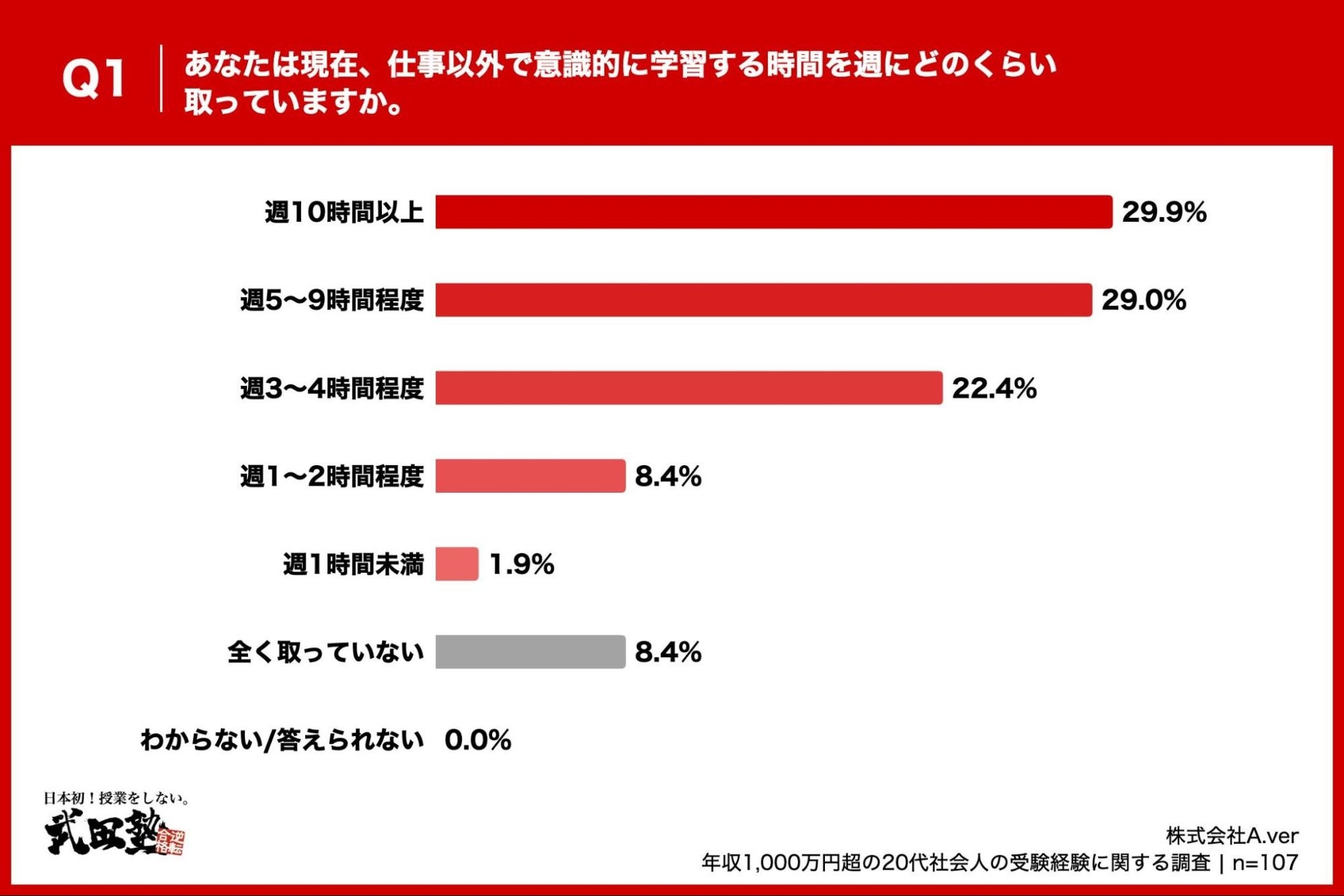
・ 10 hours or more per week: 29.9%
・ About 5 to 9 hours per week: 29.0%
・ About 3 to 4 hours per week: 22.4%
・ About 1 to 2 hours per week: 8.4%
・ Less than 1 hour per week: 1.9%
・ Not taking any at all: 8.4%
・ Don't know/Cannot answer: 0.0%
■ Learning methods utilized by high-income working adults in their 20s: "Free content such as YouTube and podcasts" topped the list at 60.2%
"Q2. We ask those who did not answer 'Not taking any at all' or 'Don't know/Cannot answer' in Q1. What method do you mainly use when learning? (Multiple answers)" (n=98) - In response to this question, "Utilizing free content such as YouTube and podcasts" was 60.2%, "Self-studying by choosing books and reference books myself" was 46.9%, and "Participating in external seminars and study groups" was 36.7%.
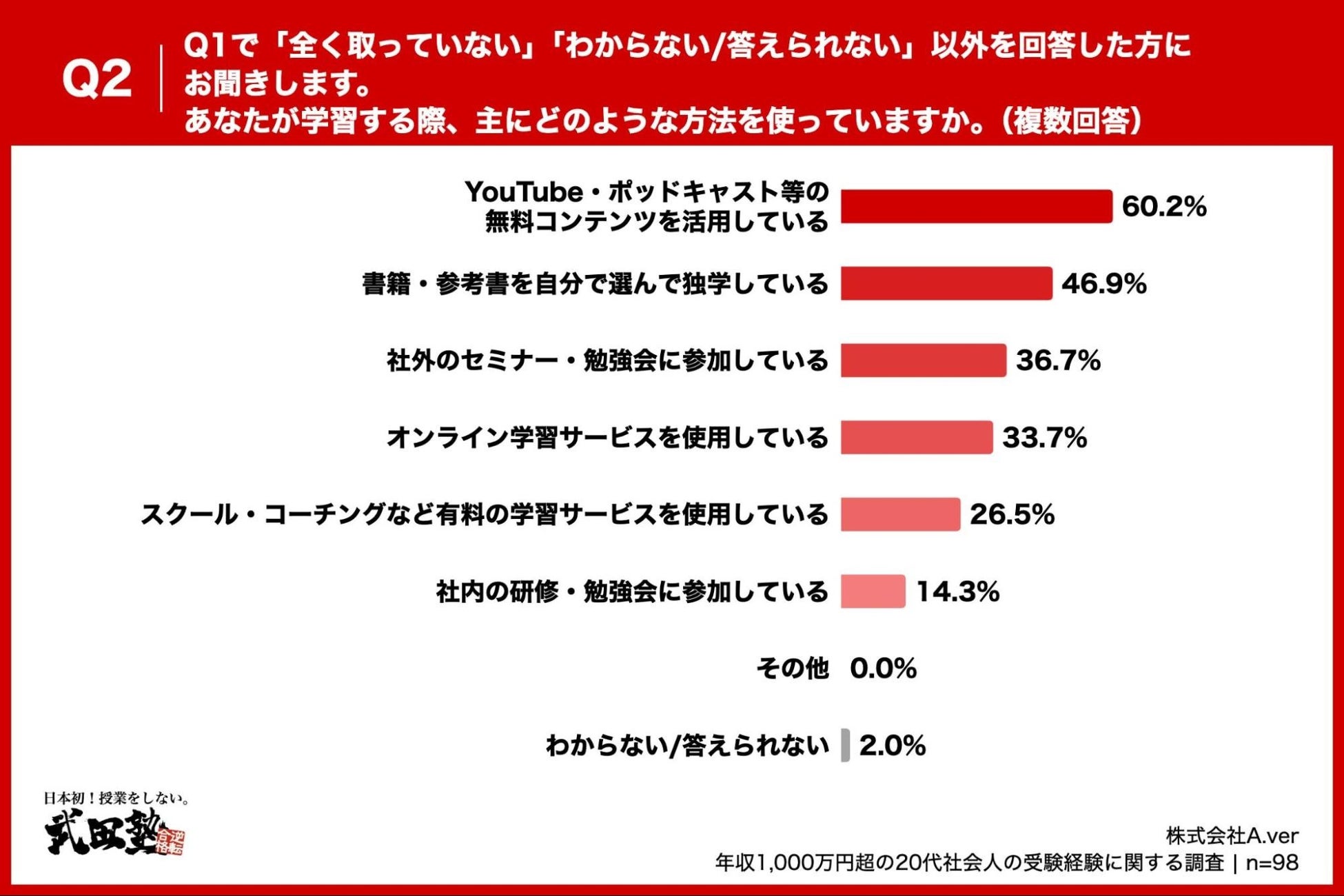
・ Utilizing free content such as YouTube and podcasts: 60.2%
・ Self-studying by choosing books and reference books myself: 46.9%
・ Participating in external seminars and study groups: 36.7%
・ Using online learning services: 33.7%
・ Using paid learning services such as schools and coaching: 26.5%
・ Participating in internal training and study groups: 14.3%
・ Other: 0.0%
・ Don't know/Cannot answer: 2.0%
■ 82.3% of high-income working adults in their 20s answered that their exam study experience "affects their current annual income"
"Q3. Do you think your experience of studying for exams affects your current annual income?" (n=107) - In response to this question, "Strongly agree" was 43.0% and "Somewhat agree" was 39.3%.
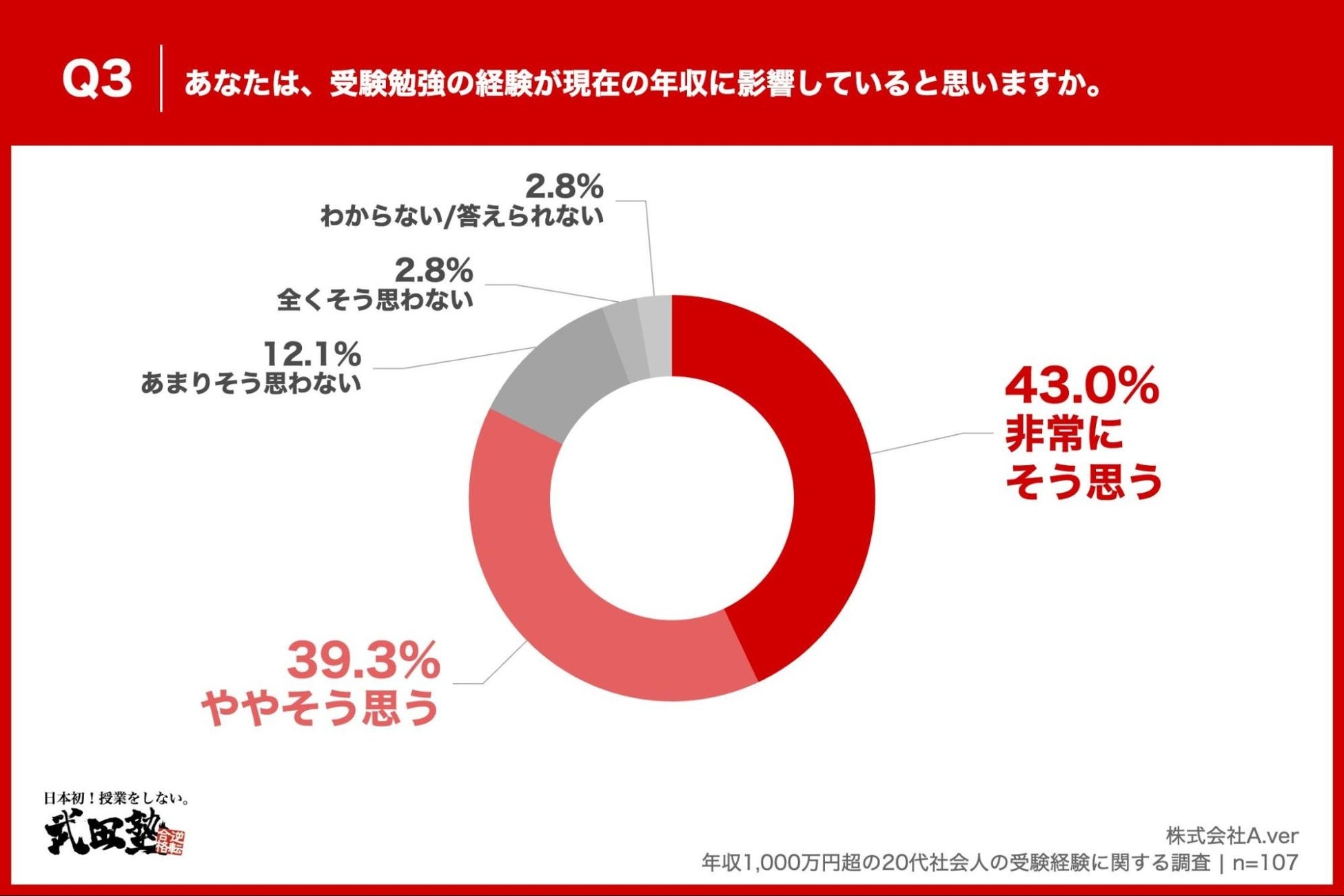
・ Strongly agree: 43.0%
・ Somewhat agree: 39.3%
・ Don't really think so: 12.1%
・ Don't think so at all: 2.8%
・ Don't know/Cannot answer: 2.8%
■ Reasons why high-income working adults in their 20s feel an impact on their annual income: "Experience in planning and execution for long-term goals" ranks first at 59.1%
"Q4. We ask those who answered 'Strongly agree' or 'Somewhat agree' in Q3. Please tell us why you think your experience of studying for exams affects your annual income. (Multiple answers)" (n=88) - In response to this question, "Because the experience of making plans toward long-term goals and executing them steadily is utilized in work" was 59.1%, "Because the study methods acquired during exams can be used directly for acquiring qualifications and improving skills" was 48.9%, and "Because I could accumulate the successful experience that 'effort yields results' through exams" was 39.8%.
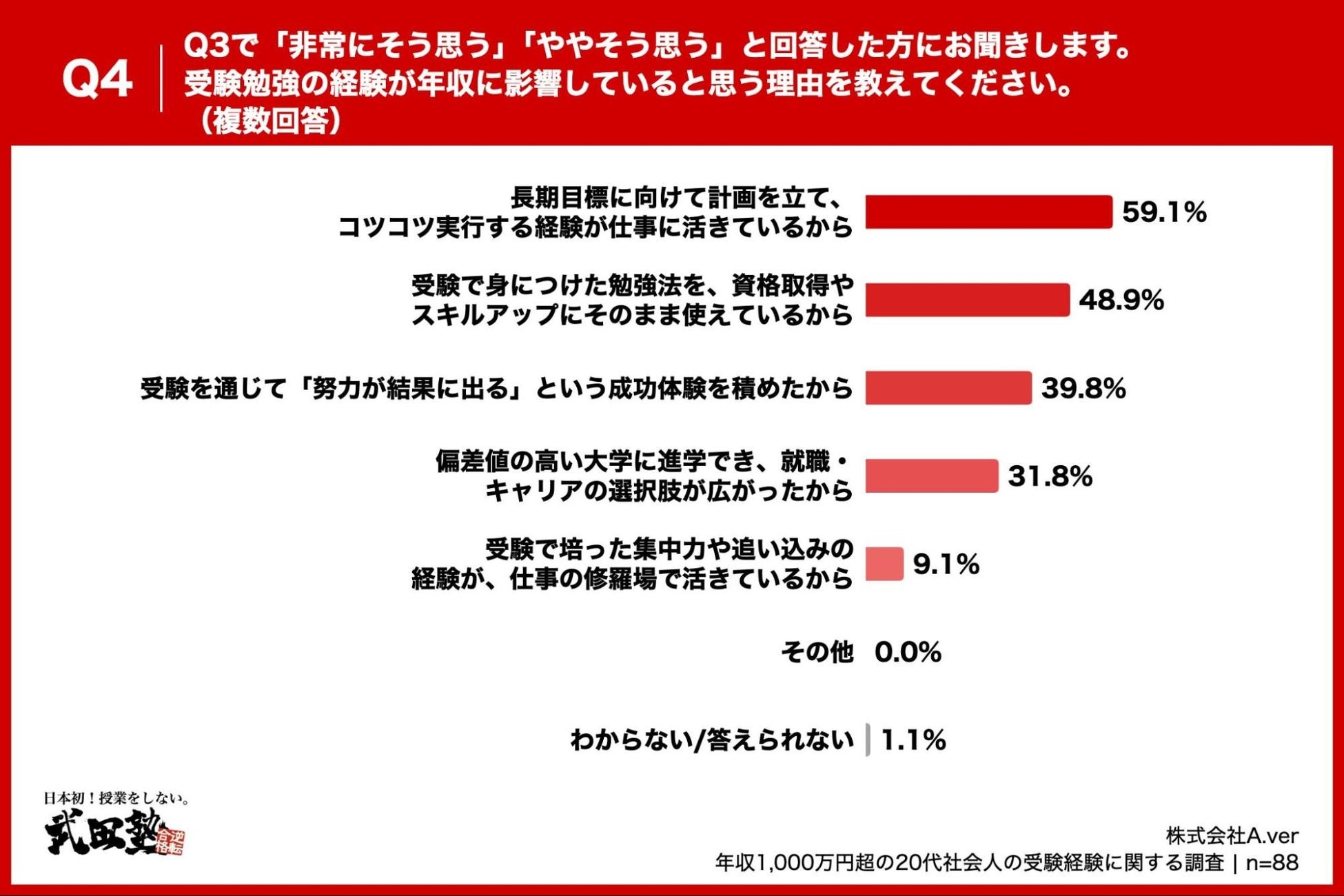
・ Because the experience of making plans toward long-term goals and executing them steadily is utilized in work: 59.1%
・ Because the study methods acquired during exams can be used directly for acquiring qualifications and improving skills: 48.9%
・ Because I could accumulate the successful experience that 'effort yields results' through exams: 39.8%
・ Because I was able to enter a university with a high deviation value, expanding employment and career options: 31.8%
・ Because the concentration and experience of pushing oneself cultivated through exams are utilized in crucial moments at work: 9.1%
・ Other: 0.0%
・ Don't know/Cannot answer: 1.1%
■ Voices include "I wouldn't have joined my current company without my academic background" and "Acquired logical thinking"
"Q5. We ask those who did not answer 'Don't know/Cannot answer' in Q4. If there are any other reasons why you think your exam study experience affects your annual income besides those answered in Q4, please feel free to tell us." (n=87) - In response to this question, we obtained 52 responses.
<Free responses/Partial excerpt>
・ Because I think I wouldn't have joined my current company without my academic background.
・ Because you can experience making an effort towards a goal.
・ Because by studying for exams, I found what I wanted to do in the future, which relates to my annual income.
・ Acquiring qualifications affected my annual income.
・ Logical thinking.
■ About 80% of high-income working adults in their 20s recall their exam days when facing a wall at work
"Q6. Do you ever recall your experiences from exam days when you face a wall at work?" (n=107) - In response to this question, "Quite often" was 34.6% and "Sometimes" was 41.1%.
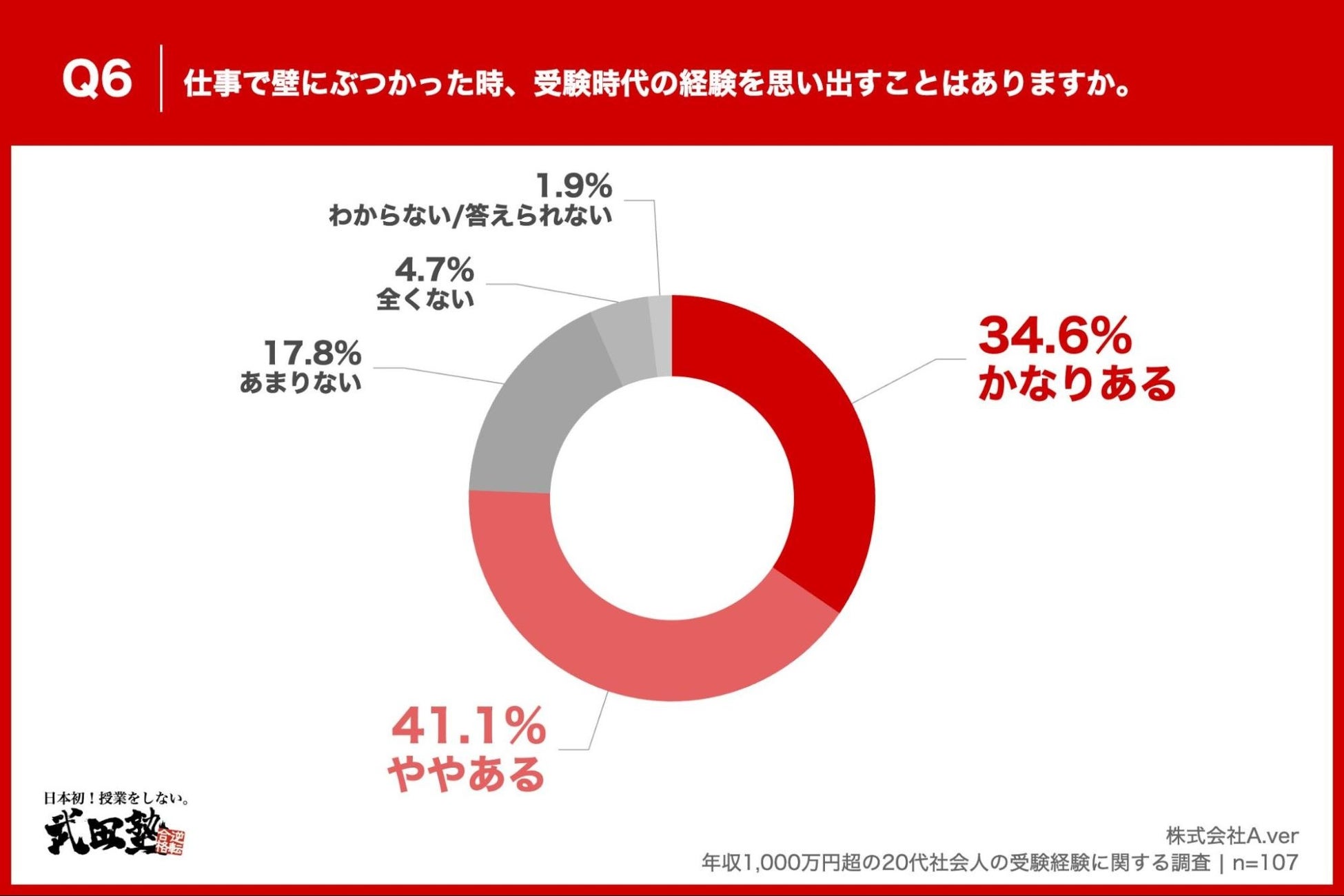
・ Quite often: 34.6%
・ Sometimes: 41.1%
・ Not very often: 17.8%
・ Not at all: 4.7%
・ Don't know/Cannot answer: 1.9%
■ 78.5% of high-income working adults in their 20s feel a difference in their approach to work compared to "people who did not properly do their exams"
"Q7. Do you feel a difference in the approach to work compared to people in your generation who 'did not properly do their exams'?" (n=107) - In response to this question, "Quite a bit" was 33.6% and "Somewhat" was 44.9%.
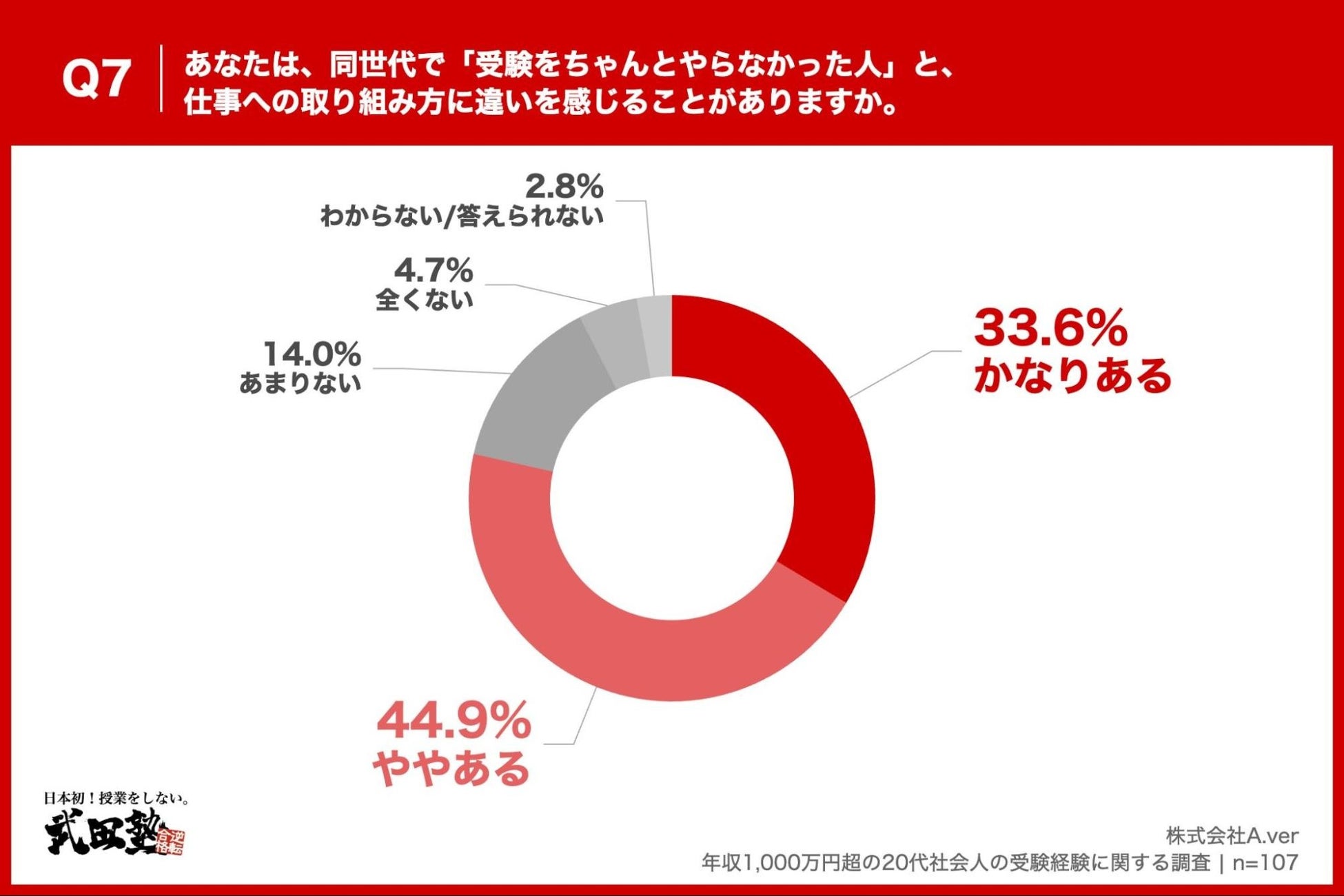
・ Quite a bit: 33.6%
・ Somewhat: 44.9%
・ Not very much: 14.0%
・ Not at all: 4.7%
・ Don't know/Cannot answer: 2.8%
■ Situations where high-income working adults feel a difference in approach: "How to make plans" (51.2%) and "Perseverance" (48.8%) rank high
"Q8. We ask those who answered 'Quite a bit' or 'Somewhat' in Q7. In what situations do you feel a difference? (Multiple answers)" (n=84) - In response to this question, "How to make plans for deadlines and goals" was 51.2%, "Perseverance when facing difficult challenges" was 48.8%, and "Concentration in pressurized situations" was 34.5%.
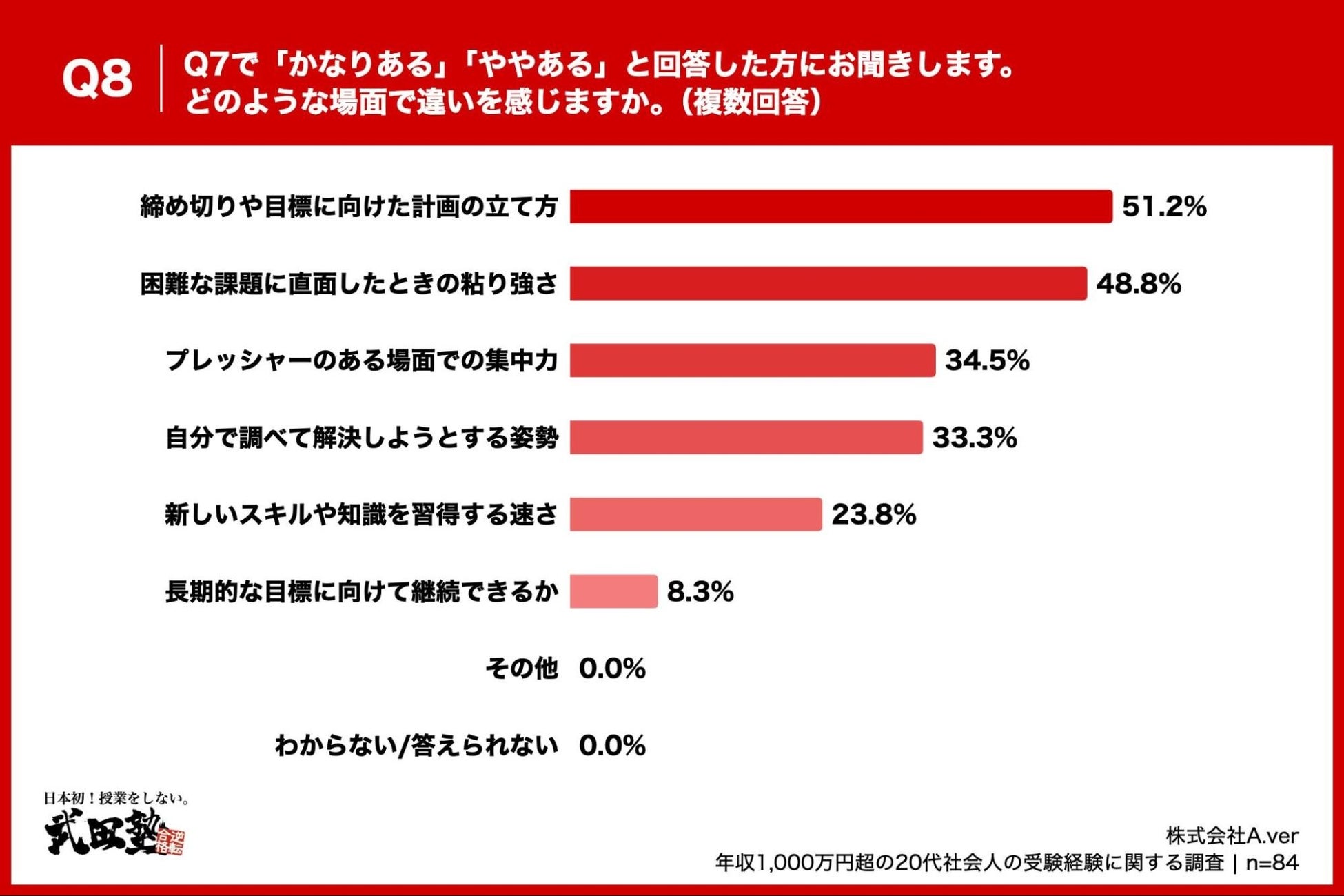
・ How to make plans for deadlines and goals: 51.2%
・ Perseverance when facing difficult challenges: 48.8%
・ Concentration in pressurized situations: 34.5%
・ Attitude to try to investigate and solve things on one's own: 33.3%
・ Speed of acquiring new skills and knowledge: 23.8%
・ Whether they can continue towards long-term goals: 8.3%
・ Other: 0.0%
・ Don't know/Cannot answer: 0.0%
■ The greatest asset high-income working adults in their 20s gained from exams: "Successful experience where effort directly led to results" at 25.2%, "Experience of recovering from setbacks" at 16.8%
"Q9. Please tell us what experience you think is the greatest asset you gained through exam study." (n=107) - In response to this question, "Successful experience where effort directly led to results" was 25.2%, and "Experience of recovering even when results were not as expected" was 16.8%.
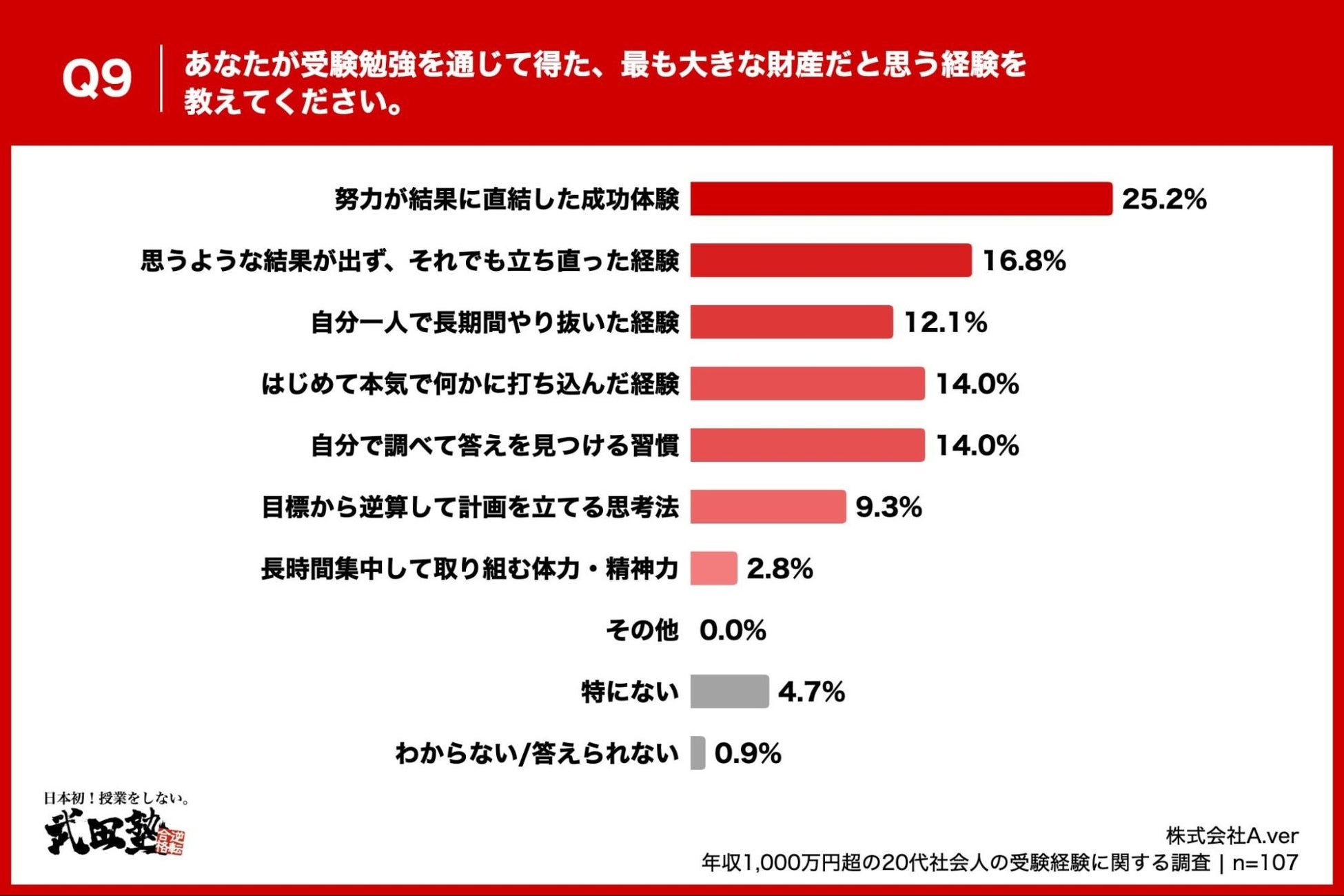
・ Successful experience where effort directly led to results: 25.2%
・ Experience of recovering even when results were not as expected: 16.8%
・ Experience of seeing things through by myself over a long period: 12.1%
・ Experience of dedicating myself seriously to something for the first time: 14.0%
・ Habit of investigating and finding answers by myself: 14.0%
・ Way of thinking to plan backward from a goal: 9.3%
・ Physical and mental strength to concentrate for long hours: 2.8%
・ Other: 0.0%
・ Nothing in particular: 4.7%
・ Don't know/Cannot answer: 0.9%
■ Summary
This time, we conducted a survey regarding the exam experiences of 107 working adults in their 20s with an annual income of 10 million yen or more who have experience taking university entrance exams. As a result, it became clear that 82.3% feel their exam study experience affects their current annual income, and 75.7% recall their experiences from exam days when they face a wall at work.
First, 58.9% secure a study time of 5 hours or more per week, and for study methods, "Free content such as YouTube and podcasts" (60.2%) ranked first. As reasons for feeling that exam study affects annual income, "Experience in planning and execution for long-term goals" (59.1%) was at the top, followed by "Utilizing study methods acquired during exams" (48.9%). Also, 78.5% feel a difference in their approach to work compared to their peers due to differences in exam experience, noticing the gap in "How to make plans for deadlines and goals" (51.2%) and "Perseverance when facing difficult challenges" (48.8%). Regarding the greatest asset gained from exams, "Successful experience where effort directly led to results" (25.2%) was the most common, followed by "Experience of recovering from setbacks" (16.8%).
From this survey, it was shown that for high-income working adults in their 20s, studying for exams is not merely a passing point, but forms the foundation of behavioral habits such as planning ability and perseverance. It can be considered that the "grit" and "attitude to systematically work towards a goal" cultivated through exams function as important assets in career formation.
■ Japan's first! What is "Takeda Juku", the cram school that does not teach classes?

Takeda Juku is Japan's first cram school that does not teach classes. We identify all the reference books needed to pass the school of your choice and the order in which to study them, and create an individual curriculum tailored to each student. All tasks to be done every day are fully specified as "homework", and retention is checked with confirmation tests. The very system of planning backward from a goal and making daily learning a habit becomes the foundation of the "planning ability" and "execution ability" that are useful even after entering society.
What Takeda Juku values is not spending money on classes, but rather the idea of spending money on "acquiring study methods". When learning new things after entering university, when challenging qualification exams, or when studying becomes necessary for work as a working adult—the way of learning acquired during exams will continue to be effective for a long time.
Think for yourself, plan, and follow through. Nurturing that power through exams. Takeda Juku provides guidance with an eye not just on "passing" but "beyond that" at schools nationwide and online.
Click here for details: https://www.takeda.tv/
■ Company Profile
Company Name: A.ver Co., Ltd.
Established: December 7, 2004
Headquarters: 4th Floor, Amano Building Main Building, 2-8-3 Hongo, Bunkyo-ku, Tokyo 113-0033
TEL: 03-5840-7678
Business Content: Operation of the cram school "Takeda Juku"