CaseMatch AI Interview Newly Releases Japanese Language Proficiency Assessment Feature
〜Leveraging AI interview expertise adopted by over 100 companies, including consulting firms and major businesses, AI automatically assesses "practical Japanese language skills" for the workplace〜
📋 Article Processing Timeline
- 📰 Published: March 31, 2026 at 23:00
- 🔍 Collected: April 1, 2026 at 13:39 (14h 39m after Published)
- 🤖 AI Analyzed: April 17, 2026 at 01:07 (371h 27m after Collected)
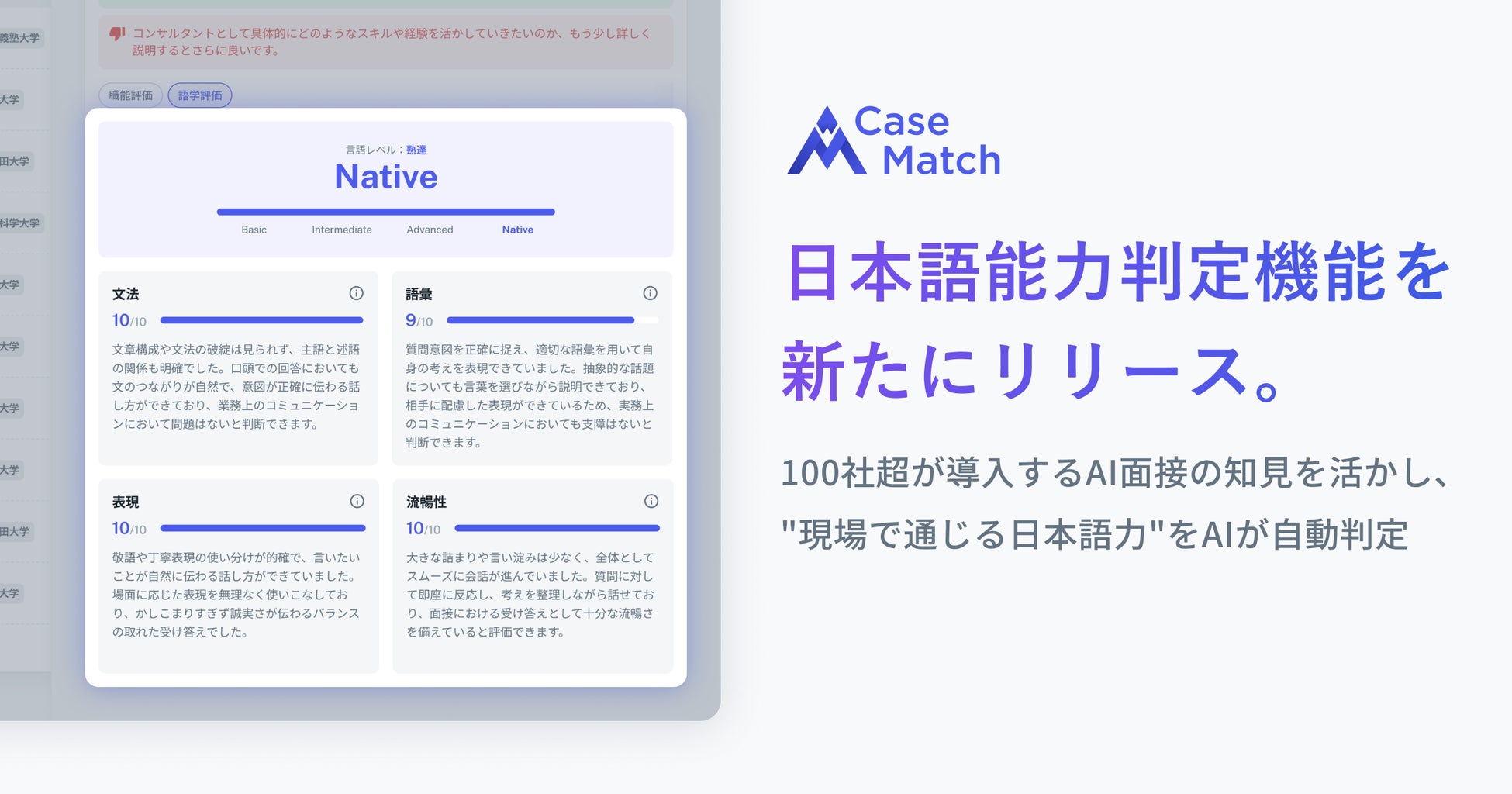
We are pleased to announce the new release of the "Japanese Language Proficiency Assessment Feature" in our AI interview service "CaseMatch," which automatically determines candidates' Japanese language ability from conversations during AI interviews.
CaseMatch has been adopted by over 100 companies, including foreign consulting firms like A.T. Kearney and major operating companies, with over 100,000 candidates having taken the interviews. For roles such as consultants, sales professionals, and marketers, advanced Japanese communication skills, including client negotiation and proposal, form the core of their work. This feature was developed by leveraging the AI interview expertise cultivated in environments where such "communication professionals" gather.
■ Background of the Release
In recent years, while the recruitment of foreign talent has accelerated due to Japan's labor shortage, assessing candidates' "practical Japanese language skills" has become a significant challenge in the recruitment field.
Even candidates who have obtained JLPT N1 often struggle with Japanese communication necessary for business operations. Especially in professional fields where communication is crucial, accurate and persuasive Japanese is indispensable for reporting to clients, making proposals, and engaging in discussions. Therefore, identifying "practical Japanese language skills" that cannot be fully measured by paper tests has become a critical recruitment issue.
In traditional selection processes, interviewers either subjectively judged Japanese language ability or required separate selection steps such as group work, leading to concerns about inconsistent evaluation standards and increased selection costs. Furthermore, there are cases where candidates whose Japanese language skills do not meet the recruitment criteria are only identified after proceeding to the interview stage, causing both companies and candidates to spend time and effort. To address these challenges, CaseMatch has developed a Japanese language proficiency assessment feature using machine learning that incorporates the latest language processing research, starting with consulting firms and major operating companies.
■ Overview of the Japanese Language Proficiency Assessment Feature
This feature automatically evaluates the Japanese language ability of candidates who have taken the CaseMatch AI interview from both transcribed data (text) and audio data. It reflects the elements of language proficiency actually required for "professions demanding high-level communication," typical of professional work.
Overall Language Assessment: 4-Level Proficiency Determination
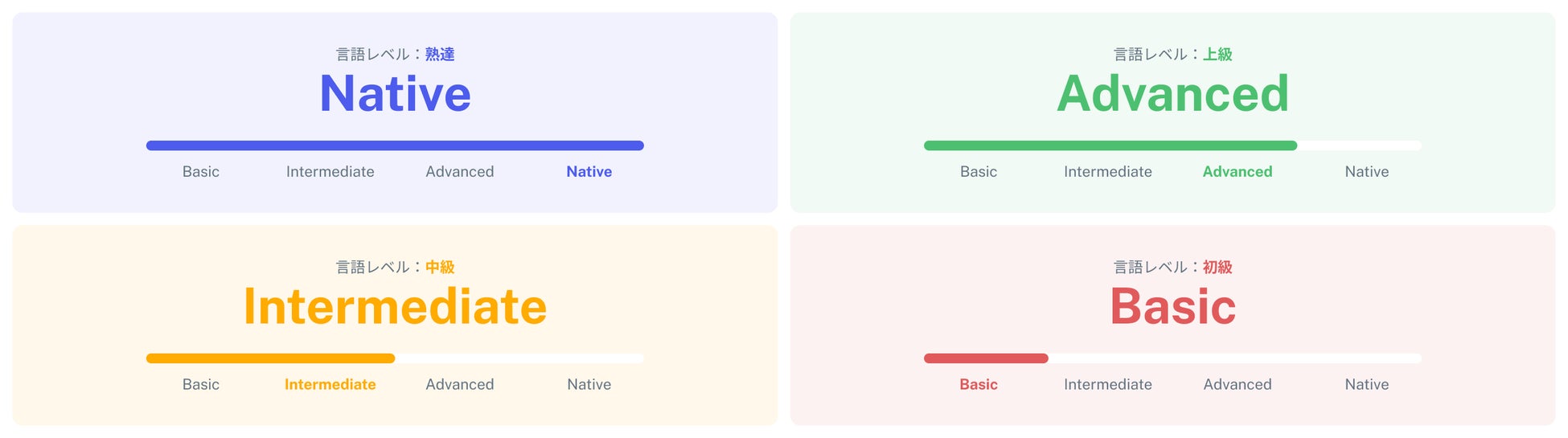
Based on the AI interview results, candidates' Japanese language proficiency is determined at the following four levels:

|
Native |
Japanese language proficiency equivalent to a native speaker |
|
Advanced |
Capable of advanced communication in business settings |
|
Intermediate |
Capable of daily conversation and basic business conversation |
|
Basic |
Capable of simple daily conversation |
Individual Assessment: Detailed Analysis in 4 Categories
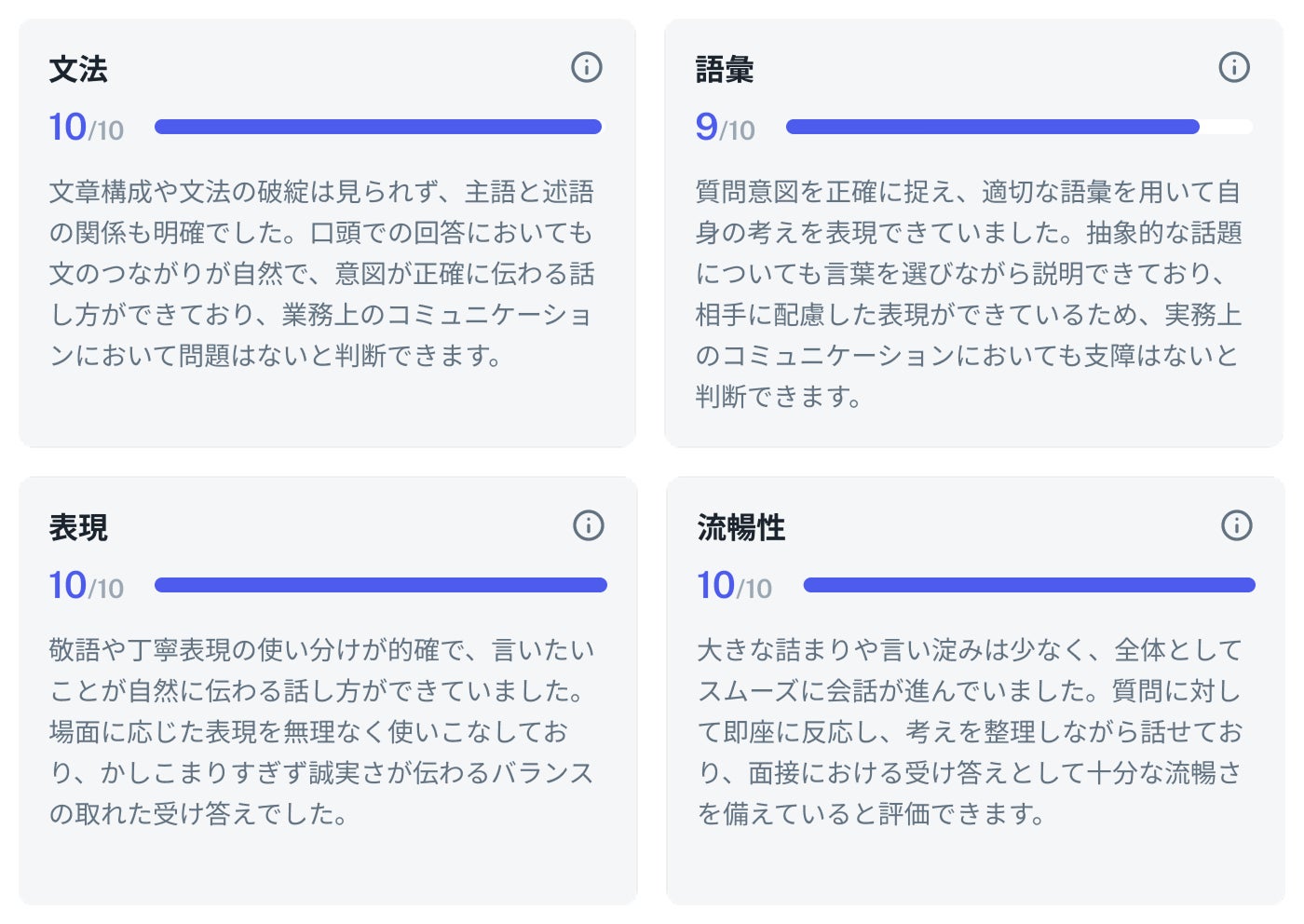
In addition to the overall level, the following four perspectives provide a 10-point score and evaluation reasons for each:
|
Grammar |
Evaluates the accuracy of overall sentence structure, such as subject-predicate agreement and correct use of particles. |
|
Vocabulary |
Evaluates the richness of vocabulary appropriate for the situation and topic, and natural collocations (word combinations). |
|
Expression |
Evaluates whether what the candidate wants to say is conveyed naturally, and the appropriate use of honorifics and polite expressions suitable for an interview. |
|
Fluency |
Evaluates whether the candidate speaks at an easy-to-understand tempo and avoids unnatural silences or long pauses. |
■ Features of This Function
1. Visualizes "Practical Japanese Language Skills" that cannot be measured by qualifications alone
Using machine learning that incorporates the latest language processing research, it automatically visualizes "practical Japanese language skills" for the workplace, which cannot be fully judged by qualification scores (JLPT, etc.) on a resume.
2. No additional selection steps required, integrated into existing AI interviews
Japanese language proficiency assessment is automatically performed during the CaseMatch AI interview, eliminating the need for separate language tests or group work. This also removes cases where additional interviews were needed solely to confirm Japanese language ability, consuming interviewer resources. It achieves high-precision language skill evaluation while keeping the selection process streamlined.
3. Objective and reproducible evaluation eliminates inconsistencies among interviewers
In traditional selection, evaluations tended to be subjective, depending on the interviewer's experience and intuition. With this feature, AI provides a 10-point score and evaluation reasons for each of the four categories, allowing anyone to grasp a candidate's Japanese language ability based on the same criteria, regardless of who or when they check. Ensuring transparency and consistency in evaluation facilitates smoother consensus building within the recruitment team.
■ Use Cases
Screening Japanese communication skills in global talent recruitment. Assessing practical level Japanese language skills for new graduates and mid-career foreign talent. Considering assignment to departments/projects based on language proficiency. Reducing man-hours for reviewing existing interview videos.
■ Future Outlook
CaseMatch will continue to expand support for languages other than Japanese and further enhance voice analysis technology to establish a standard for language proficiency assessment in global recruitment. We will strive for continuous improvement in evaluation accuracy based on the latest technology and research, using the high-level communication skills required in professional fields, including consulting firms and major operating companies, as our measurement foundation.
■ About CaseMatch
"CaseMatch" is a patent-pending AI interview service where AI conducts and evaluates interviews with candidates in a conversational format. Candidates can take the interview 24/7 from smartphones or PCs, and customized evaluation models can be designed according to the company's job type and grade. It has been adopted by over 100 companies, including foreign strategic firms like A.T. Kearney, general consulting firms, major Japanese companies, and mega-ventures, with a cumulative total of over 100,000 candidates.
※For inquiries regarding this release, please contact us here:https://biz.casematch.jp/contact
【Company Profile】
・Company Name: Azuni Co., Ltd.
・Representative Director: Takuya Matsumoto
・Established: December 2023
・Location: 7F Minami Aoyama HY Building, 7-3-6 Minami Aoyama, Minato-ku, Tokyo
・Website for Recruiters: https://biz.casematch.jp/usecase/ai_interview
FAQ
What is CaseMatch's Japanese language proficiency assessment feature?
It's a feature that automatically evaluates a candidate's Japanese language ability from conversations during an AI interview. It visualizes "practical Japanese language skills" that cannot be measured by qualifications like JLPT.
What problems does this feature solve?
It solves challenges such as assessing "practical Japanese language skills" in foreign talent recruitment, inconsistencies in interviewer evaluations, and increased screening costs, enabling objective and efficient assessment.
How is the evaluation conducted?
Evaluation is performed from both transcribed data and audio data, across four categories: grammar, vocabulary, expression, and fluency, with a 10-point score for each and a 4-level overall proficiency rating.