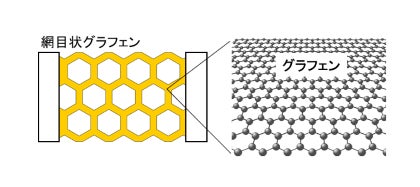
Anritsu Corporation (President Koichi Hamada) has discovered that nanoscale reticulated graphene exhibits thermal conductivity characteristics that differ from conventional understanding at room temperature. This discovery was made by Anritsu's Advanced Technology Research Laboratory (hereinafter referred to as the Advanced Research Lab), and the research results have been published in the international scientific journal "2D Materials." https://doi.org/10.1088/2053-1583/ae525a
While smartphones, 5G devices, and personal computers are becoming smaller and more powerful, they face the challenge of accumulating heat internally. Therefore, heat dissipation technology is essential for the future evolution of electronic devices. Graphene, which efficiently dissipates heat, is attracting attention as a heat dissipation material due to its ultra-thin, lightweight, and flexible properties. This discovery has confirmed its promise not only for dissipating heat but also for thermal management, which involves controlling the direction of heat flow. These characteristics are expected to be applied in the development of various fields such as next-generation electronics, energy, communications, and medicine. What is Graphene? Graphene is a sheet in which carbon atoms are bonded in a honeycomb structure. Graphite, which is used in pencil lead, is a layered structure of graphene. Being only one atom thick, it is extremely thin and lightweight, in addition to possessing very high strength and flexibility. Furthermore, due to its high crystallinity, it is known to conduct heat very well. For example, silver has the highest thermal conductivity among metals, but graphene exhibits a thermal conductivity approximately 10 times higher. Mechanism of Reticulated Graphene In this research, we attempted to control the thermal conductivity characteristics by creating a regular structure on graphene at an extremely small scale, on the order of nanometers [*]. Normally, as the structure becomes finer, the thermal conductivity decreases. In fact, for strip-shaped graphene, heat becomes harder to transfer as the width decreases. On the other hand, we found that for reticulated graphene, the thermal conductivity actually increases with finer structures. This is thought to be the result of the heat flow overlapping and reinforcing each other like waves due to the reticulated fine structure. Such a phenomenon was previously only observed at extremely low temperatures close to -273°C, and confirming it at room temperature is a significant achievement. Simultaneously, it was shown that the thermal conductivity can be varied by adjusting the width of the graphene, and therefore, by changing the structure at different locations within the graphene element, the heat flow can potentially be controlled. By applying this technology, it is expected that a mechanism for controlling heat flow based on an entirely new principle can be designed. <figcaption class="pr
FACT BOX
- Source: PR TIMES
- Category: News