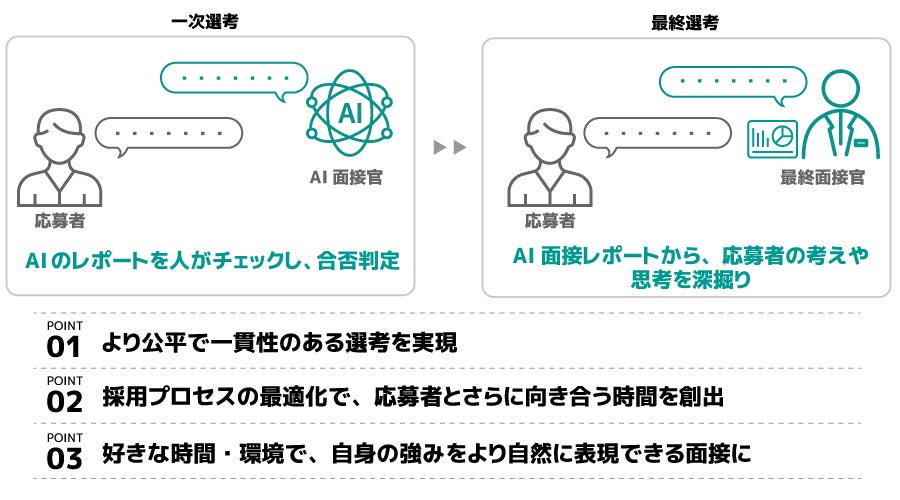
Altious Link, Inc. (Location: Shibuya-ku, Tokyo; President & CEO: Masatoshi Natan, hereinafter Altious Link) has introduced AI interviews*2 as part of its Corporate DX*1 initiative for the first round of interviews for new graduate recruitment. Through our BPO business, we have been continuously working to improve operational efficiency while identifying "areas where humans should add value." This initiative applies that policy to the recruitment process. By standardizing evaluations with AI and visualizing applicant qualifications, we aim to enhance the time and quality spent engaging with each applicant, leading to further improvements in the applicant experience.
Background of Introduction - Standardization of Evaluation Criteria and Strengthening of Selection System as Challenges In recent years, with intensifying recruitment competition, the importance of strengthening touchpoints with applicants and mutual understanding has grown, leading to a broader re-examination of evaluation concepts and recruitment processes. At our company, variations in the content and perspectives of evaluation reports written by interviewers led to differences in the granularity of applicant information shared with the final interviewer. Furthermore, with 80 managers outside the recruitment department responsible for the first interview, reducing the administrative workload associated with selection was a challenge for the recruitment staff as well. In response to this situation, we recognized the need to optimize the recruitment process and have been repeatedly considering whether the knowledge gained from utilizing AI and technology in our various services could be applied to the recruitment domain. On the other hand, the spread of AI utilization in the recruitment field has been limited, with a Nikkei survey indicating that AI utilization in "interviews" remains at only 4.5%. Based on these challenges and the social context, we decided to introduce AI interviews as part of our recruitment DX to improve the quality of interviews and the applicant experience, while standardizing evaluation criteria and building a selection system that allows for greater focus on dialogue with applicants. Introduction Effects - Fair and Unified Evaluation Axis by AI and Improved Interview Quality Through Interview Reports To fully introduce AI interviews, we conducted phased implementation and effect verification in the recruitment activities for the graduating class of 2027. We confirmed the consistency between AI scores in 10 evaluation items and the evaluations by recruitment staff, and verified the impact on the applicant experience and the efficiency of the recruitment process, leading to the decision to implement it in the main recruitment. ・Improved Interview Quality: Standardization and visualization of evaluation perspectives enable deeper dives in the final interview The standardization of evaluation axes by AI suppresses variations in evaluation, organizes and visualizes the characteristics and strengths of each applicant, and facilitates smooth information sharing for the final selection. Interviewers responsible for the final interview provided feedback such as: "Being able to grasp the content of the first interview in advance allows us to delve deeper into the applicant's thoughts and aspirations within the limited time." "Referring to the AI score clarified the points that needed confirmation." Going forward, we will consider the possibility of utilizing the qualitative information obtained during the selection process for post-hire training and placement considerations.
・Optimization of Recruitment Process: Reduced operational burden and reallocation of time to applicant communication We anticipate a reduction of approximately 95% in the workload for recruitment-related tasks, which traditionally required about 1,200 hours for interview operations, scheduling, etc. This will lead to a system where recruitment staff can focus more on communication and follow-up with applicants. Specifically, this includes expanding recruitment content and fostering communication with applicants.
FACT BOX
- Source: PR TIMES
- Category: News