CUBE-LIO Wins Best Paper Award at Robotics Symposia
Panasonic Advanced Technology's research, "CUBE-LIO," has been honored with the Best Paper Award at the prestigious Robotics Symposia, a leading academic conference in Japan. This recognition highlights CUBE-LIO's significant advancements in LiDAR Inertial Odometry (LIO), achieving superior accuracy and stability compared to existing methods. The innovation stems from its novel use of LiDAR intensity information, cubemap projection, and intensity gradient magnitude optimization.
📋 Article Processing Timeline
- 📰 Published: March 31, 2026 at 19:30
- 🔍 Collected: April 1, 2026 at 13:39 (18h 9m after Published)
- 🤖 AI Analyzed: April 17, 2026 at 01:13 (371h 33m after Collected)
Panasonic Advanced Technology Co., Ltd. (Head Office: Kadoma City, Osaka; hereinafter, "the Company") is pleased to announce that its research achievement, "CUBE-LIO," has received the Best Paper Award at "Robotics Symposia," one of Japan's leading academic conferences in the field of robotics. This award was selected based on a comprehensive evaluation including the novelty, technical validity, experimental results, and presentation content of the proposed method.
■ Overview of the Award
Robotics Symposia is an academic conference characterized by rigorous peer review and active discussions in the field of robotics, where the Best Paper Award is given to particularly outstanding research among accepted papers.
The award-winning "CUBE-LIO" was highly evaluated for achieving improved accuracy and stability compared to conventional methods in self-localization using LiDAR and IMU (LIO: LiDAR Inertial Odometry).
LiDAR: Light Detection and Ranging: A sensing technology that measures the distance and shape of objects quickly and with high precision by emitting laser light and measuring the time it takes for the reflection to return.
IMU: Inertial Measurement Unit

■ Core Technologies of CUBE-LIO
This research focused on the "intensity" information inherently possessed by LiDAR.
The paper demonstrates the following three technical contributions:
-
Cubemap Projection
Many conventional methods use "equirectangular projection," which causes significant distortion near the poles.
CUBE-LIO adopts a method of projecting 3D point clouds onto 6-sided cube images.
-
Significantly reduces distortion near the poles
-
Reduces computational load (approximately 38-43% faster in ablation studies)
-
Supports solid-state LiDAR
Its superiority is particularly evident in cases of downward observation or wide-angle observation, such as with drones.
-
-
IGM (Intensity Gradient Magnitude) Optimization
We propose a method that directly optimizes the "intensity gradient (rate of change)" instead of raw intensity values.
This allows for the construction of photometric constraints robust to:
-
Changes in distance
-
Changes in angle of incidence
-
Sensor noise
Ablation results show that IGM optimization is clearly more accurate than simple intensity optimization.
-
-
Simultaneous Optimization of Geometric and Photometric Constraints
In addition to conventional geometry-based LIO, intensity gradient constraints are integrated with tight coupling.
As a result:
-
Outperformed COIN-LIO in 9 out of 10 sequences in the ENWIDE dataset
-
Achieved best accuracy in degenerate environments of MARS-LVIG
-
Significantly reduced drift in featureless environments
These results surpassed existing SOTA (State-of-the-Art).
In particular, its stability in long, flat walls, low-feature environments, and tunnel environments is a major differentiating factor.
-
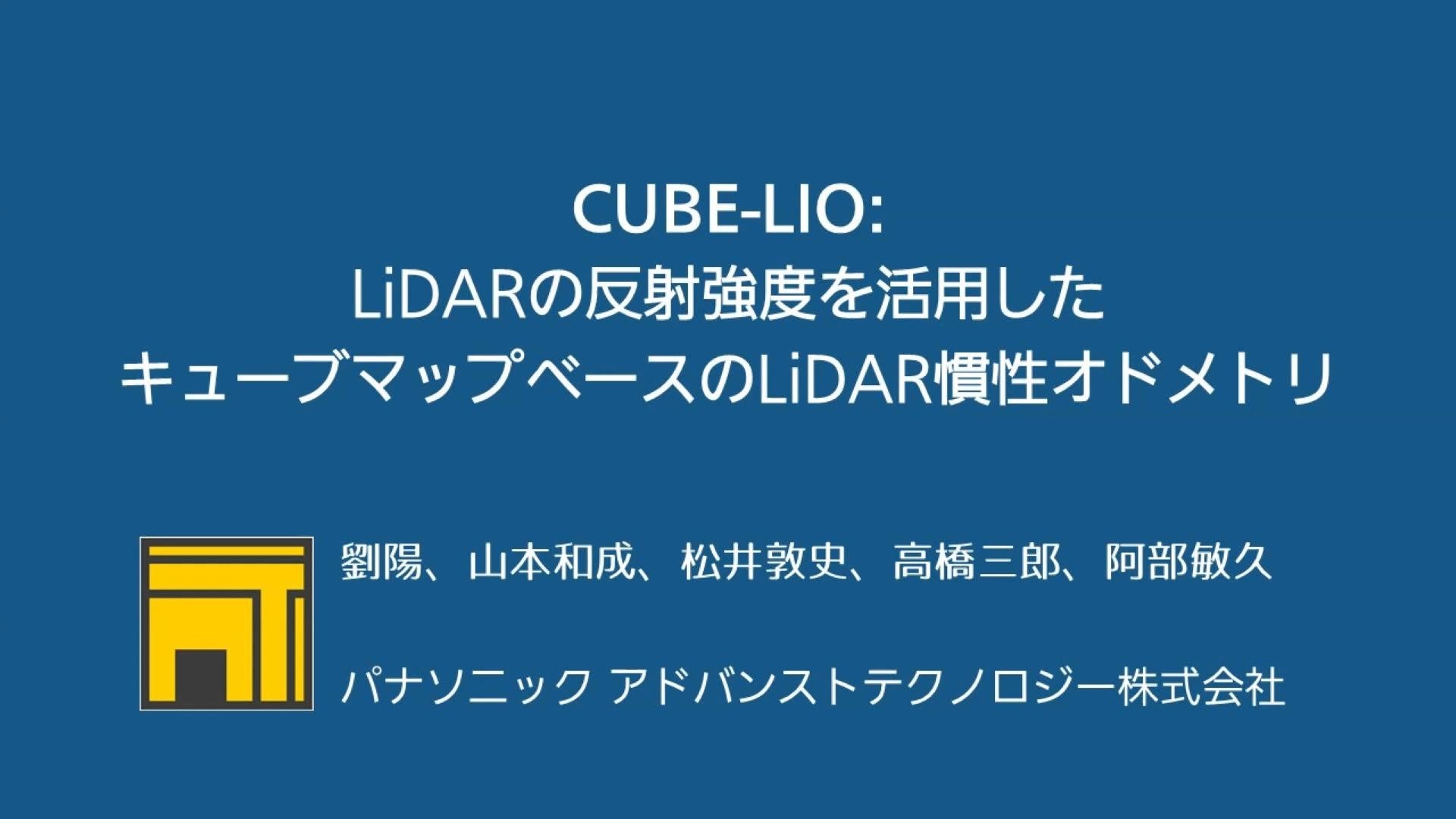
■ Video
A video explaining the paper can be found here. You can watch a video demonstrating performance comparisons and CUBE-LIO's features.
■ Integration into Our Products
These research results will be integrated into the following Company products:
This will achieve:
-
Improved AMR positioning accuracy in monotonous environments such as factories and warehouses
-
Improved spatial awareness accuracy in low-feature spaces such as tunnels
-
Enhanced robustness in degenerate environments for drone surveying applications
■ Future Outlook
The Company will continue to promote research and development in robotics and spatial recognition technology, contributing to the resolution of societal challenges. We will also accelerate deployment into industrial fields while balancing academic achievements and practical technologies.
About Panasonic Advanced Technology
Panasonic Advanced Technology Co., Ltd., an affiliate of Panasonic Holdings Corporation, focuses on software and system development, providing advanced technologies for social infrastructure and mobility fields.
We promote societal automation with advanced software technology in the mobility domain, including the development of in-vehicle ECUs compliant with automotive functional safety, autonomous driving systems for construction machinery, and material handling robots that support logistics sites.
Furthermore, as our own products, we offer practical solutions such as the autonomous mobile robot software package "@mobi," the easy 3D space scanner "@mapper," and the wireless emergency stop device "@seguro wes" compliant with functional safety standards.
Beyond mobility technology, we are also engaged in IoT, housing, medical, and security fields, aiming to create future social infrastructure centered on safety and security.