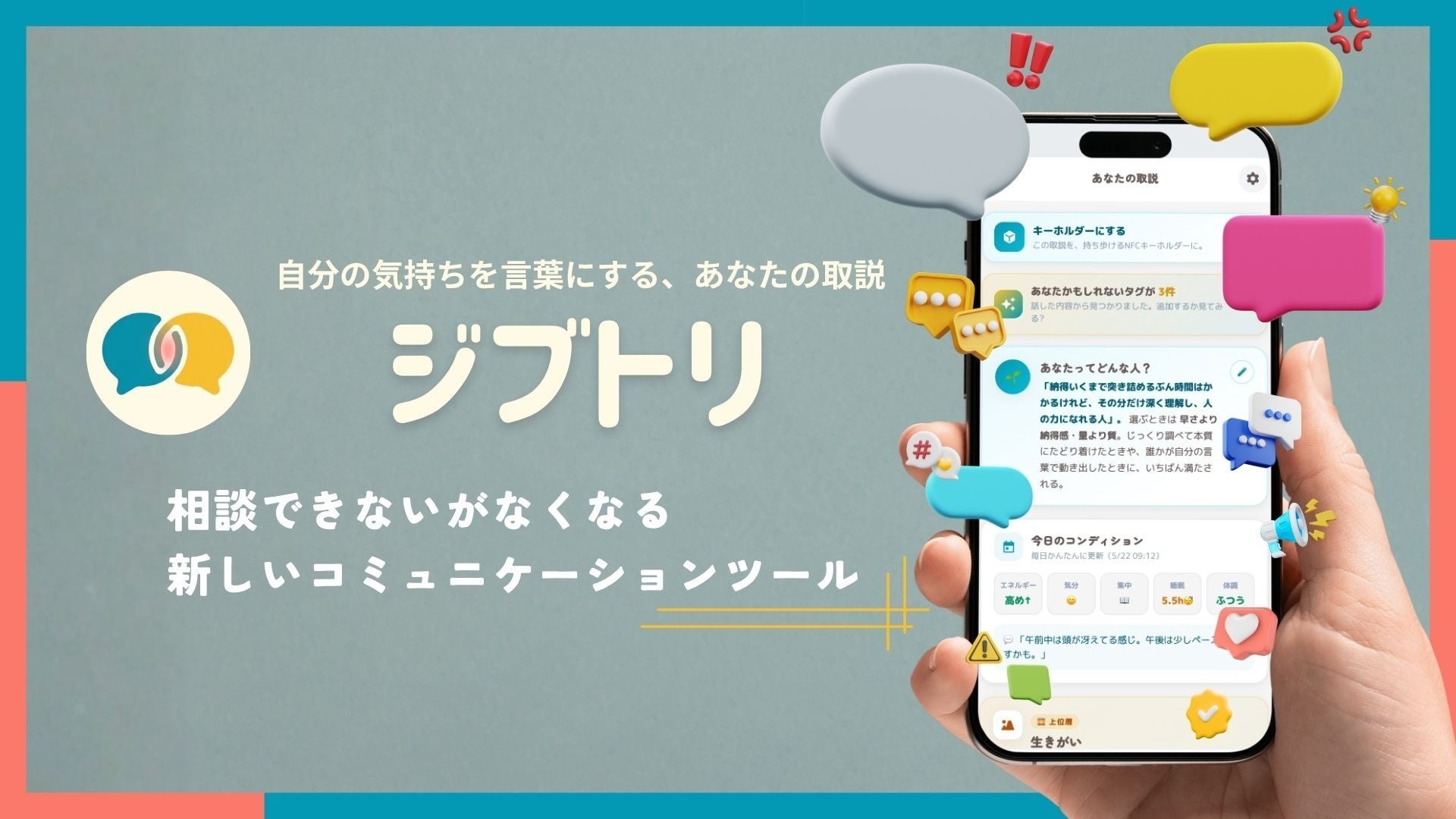
Under the concept of 'an experimental zone to enrich the world 100 years from now,' the Formeet Project, active at 100BANCH—a future-creation hub collaborating with young generations to create new values—has developed 'Jibutori,' a self-understanding service that creates a 'user manual for oneself (user guide)' through AI dialogue. It will be unveiled for the first time at 'Nanananasai,' held at Shibuya's 100BANCH from July 10–12, 2026.
Background: 'Workplaces Without Consultation' Are Losing Unique Talent
Talented individuals who thrived as 'the interesting ones' in school are labeled as having developmental disorders upon entering society, treated as social liabilities, and end up resigning or taking leave without being able to consult anyone. This is not only a personal issue but also a significant talent loss for companies.
Highly capable individuals with unique senses and characteristics lose their ability to perform the moment they enter society. The root cause is often not lack of ability, but the absence of opportunities for consultation.
Three barriers prevent consultation:
1. Learned helplessness from past experiences where 'consulting is useless'
2. Difficulty in verbalizing one's own feelings and habits to others
3. Strong self-blame mentality, thinking 'it's all my fault'
Due to these three barriers, issues that could have been resolved with a single conversation and minor consideration escalate into major costs such as burnout, leave of absence, and resignation.
'Jibutori' is a self-understanding service developed to transform this 'structure where consultation does not occur,' enabling users to create their own 'user manual' through dialogue with AI.
New Service: 'Jibutori' — A Self-Understanding Service That Creates Your User Manual with AI
<Features of 'Jibutori'>
Jibutori is a self-understanding service designed to foster consultation. It has three unique features:
1. Create your 'user manual' through dialogue with AI
Through AI dialogue, users can verbalize feelings, habits, and emotions they weren't even aware of. It translates the background behind a simple statement like 'I'm not making progress'—such as difficulty with backward planning or a preference for auditory information processing—into actionable language that others can understand and respond to.
2. Puzzle-Piece Keychain: Anti-Stigma Design That Treats 'Dents' as Connection Points, Not Flaws
The 'dent' on the keychain generated from diagnostic results is designed not as a flaw, but as a 'connection point' that fits with others' 'protrusions.' It embodies the philosophy that strength emerges not from individual completeness, but from mutual complementarity—made tangible and holdable.
3. 'Evaluation Separation' Design: Never Using Trait Data for Personnel Evaluation
The principle is never to use collected trait data for performance evaluation. If tools meant to foster open communication are used for evaluation, the tools themselves become ineffective. This design philosophy is foundational, especially for organizational deployment.
<Social Significance>
While awareness of developmental disorders has increased, a distorted perception has spread that all individuals with such labels are the same. The uneven brain development once accepted as individuality in classrooms is no longer accepted in society, making it difficult even to consult. This represents a societal loss—talented individuals who could thrive are buried without realizing their potential.
Jibutori aims to reframe traits not as 'flaws to be fixed' but as 'connection points to engage.' It seeks to foster naturally occurring consultation in relationships, both for individuals and organizations.
Future Development: Building an Organizational 'System Where Talent Doesn't Quit'
Jibutori will first be offered as a service for individuals to understand themselves. Then, it will expand into organizational use, aiming to directly improve corporate talent retention.
Mutual Understanding and 1-on-1 Support: Based on each member's user manual, managers and colleagues will understand concretely 'what actions can unlock their potential' at an actionable level.
Safe Data Foundation via Evaluation Separation: By ensuring trait data is never used in personnel evaluation, it creates a safe foundation where employees can self-disclose without fear.
Application in Human Capital and Health Management: Aiming to contribute to improving metrics in human capital and health management, such as employee engagement and retention rates.
July 10–12: Touch & Try Event
To mark the first public unveiling of the self-understanding service 'Jibutori,' a Touch & Try event will be held at Shibuya's 100BANCH from July 10–12. Attendees can experience the AI in action and try the full service. Companies involved in HR, strategic planning, human capital, or health management can also consult on potential implementation while experiencing the product firsthand. We welcome your visit and inquiries.
<Event Experience>
User Manual Creation Experience with AI: Experience creating your own user manual through dialogue with AI (trial version). Puzzle-Piece Keychain: Answer 13 questions and receive a keychain representing your communication style on the spot.
<Event Overview>
Event Name: 100BANCH Nanananasai 'Torisetsu Factory – Would You Like to Create Your User Manual?'
Dates: July 10 (Fri), 11 (Sat) 12:00–20:00, July 12 (Sun) 12:00–18:00
Venue: 100BANCH 2F (3-27-1 Shibuya, Shibuya City, Tokyo)
Experience Fee: Free (Keychain creation: 1,000 JPY)
Project Leader Comment: Ayuki Nakata, Representative, Formeet Project
When I reunited with a friend who was bright and positive in middle school, he had become completely negative. When I asked why, he said, 'I can't consult anyone about my workplace struggles.' Reflecting back, the people I supported as a volunteer also initially needed help due to the same issue.
From this realization, I spoke with over 170 people, including those affected, companies, and welfare facilities. What I felt was that this hardship is labeled as mental or developmental disorders, but in reality, it may not be an individual issue, but a structural problem of society.
Currently, welfare and support systems activate only after a diagnosis is made. Yet in reality, among full-time employees who took leave due to mental health issues, only about half were able to return to their original company after leave, while the remaining half left through resignation or job transfer (※).
That's why I aim to create a workplace environment before diagnosis is needed, where AI takes the burden of 'not being able to speak up,' enabling consultation to naturally occur. To build a society where diagnosis isn't necessary—not through welfare, but through systemic design. That is my goal.'
※ Source: Survey on the Actual Status of Leave Due to Mental Health Issues (Leverages Corporation, conducted July 2025)
[Project Overview]
Project Name: Formeet Project
Representative: Ayuki Nakata
Email: info@formeet.jp
Business: Self-understanding and communication support services
※ Inquiries regarding corporate adoption and collaboration are welcome via the above email.
About 100BANCH
'An experimental zone to enrich the world 100 years from now'
FACT BOX
- Source: PR TIMES
- Category: New Product