[Okayama University] Analysis of Infection Status and Healthcare Provision System in Okayama Prefecture (As of March 16, 2026)
Okayama University weekly publishes analysis of COVID-19 infection status and healthcare provision system in Okayama Prefecture.
📋 Article Processing Timeline
- 📰 Published: March 30, 2026 at 10:21
- 🔍 Collected: March 30, 2026 at 09:00
- 🤖 AI Analyzed: April 15, 2026 at 10:00 (384h 59m after Collected)
March 30, 2026
National University Corporation Okayama University
◆ Overview
We have compiled data on patient reports and the healthcare provision system published on the Okayama Prefecture website (*) and added comments from a group of experts in Okayama Prefecture. We plan to update this information once a week.
Additionally, we have created a single-page, easy-to-understand representation, referencing the Tokyo Metropolitan Government's "Analysis and Summary Comments on Latest Monitoring Items." We hope this will be helpful in understanding the situation within the prefecture.
Although the WHO has declared the end of the COVID-19 pandemic and normal life is returning to Japan, we are continuing to provide information to help grasp the infection and healthcare system status in Okayama Prefecture, and as a reference for infection prevention measures in your daily lives. Thank you for your understanding.
* Since the transition to Category 5 infectious disease, we have been using the number of reported cases per sentinel surveillance point.
◆ Analysis of Infection Status and Healthcare Provision System [As of March 16, 2026 (Monday)]
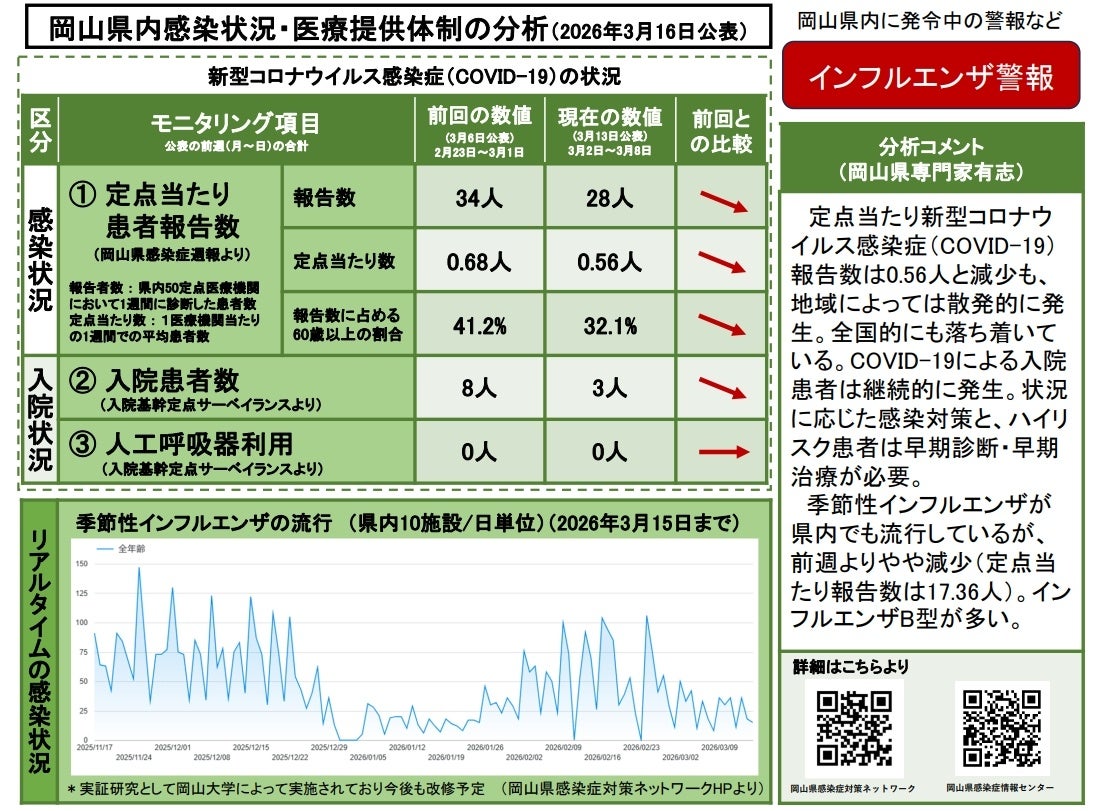
The number of reported cases of COVID-19 per sentinel surveillance point has decreased to 0.56, but sporadic outbreaks are occurring in some areas. The situation is also calm nationwide.
Hospitalizations due to COVID-19 continue to occur. Appropriate infection control measures are necessary depending on the situation, and early diagnosis and early treatment are essential for high-risk patients.
Seasonal influenza is prevalent in Okayama Prefecture, but it has slightly decreased compared to the previous week (17.36 reported cases per sentinel surveillance point). Influenza type B is more common.
◆ Experts Group in Okayama Prefecture
Yasunori Ichimura (International Medical Cooperation Bureau, National Institute for Health Crisis Management)
Hideo Hagiya (Department of Infectious Diseases, Okayama University Hospital)
Koji Fujita (Department of General Internal Medicine and Infectious Diseases, Tsuyama Chuo Hospital)
Harushi Yamada (Department of Infectious Diseases, Okayama City General Medical Center)
Daisuke Yoshioka (Clinical Infectious Diseases, Kawasaki Medical School & Hospital Infection Control Office, Kawasaki Medical University)
Takashi Yorifuji (Department of Epidemiology and Hygiene, Graduate School of Medicine, Dentistry and Pharmaceutical Sciences, Okayama University)
(In Japanese syllabary order)
FAQ
What is the purpose of this report from Okayama University?
The report aims to analyze and provide updates on the COVID-19 infection status and the healthcare provision system in Okayama Prefecture, based on publicly available data. It also serves as a reference for infection prevention measures in daily life.
How often is this analysis updated?
The analysis is planned to be updated once a week.
What data is used for the analysis?
The analysis uses patient report numbers and data on the healthcare provision system published on the Okayama Prefecture website. Since the transition to Category 5 infectious disease, the number of reported cases per sentinel surveillance point is used.
What is the current COVID-19 situation in Okayama Prefecture as of March 16, 2026?
The number of reported COVID-19 cases per sentinel surveillance point has decreased to 0.56, with sporadic outbreaks in some areas. The situation is calm nationwide. Hospitalizations continue to occur, and early diagnosis and treatment are recommended for high-risk patients.
Is influenza also being monitored?
Yes, seasonal influenza is prevalent in Okayama Prefecture, though it has slightly decreased compared to the previous week. Influenza type B is more common.
Who are the experts contributing to this analysis?
The analysis is contributed by a group of experts from various institutions in Okayama, including the National Institute for Health Crisis Management, Okayama University Hospital, Tsuyama Chuo Hospital, Okayama City General Medical Center, Kawasaki Medical University, and the Graduate School of Medicine, Dentistry and Pharmaceutical Sciences at Okayama University.