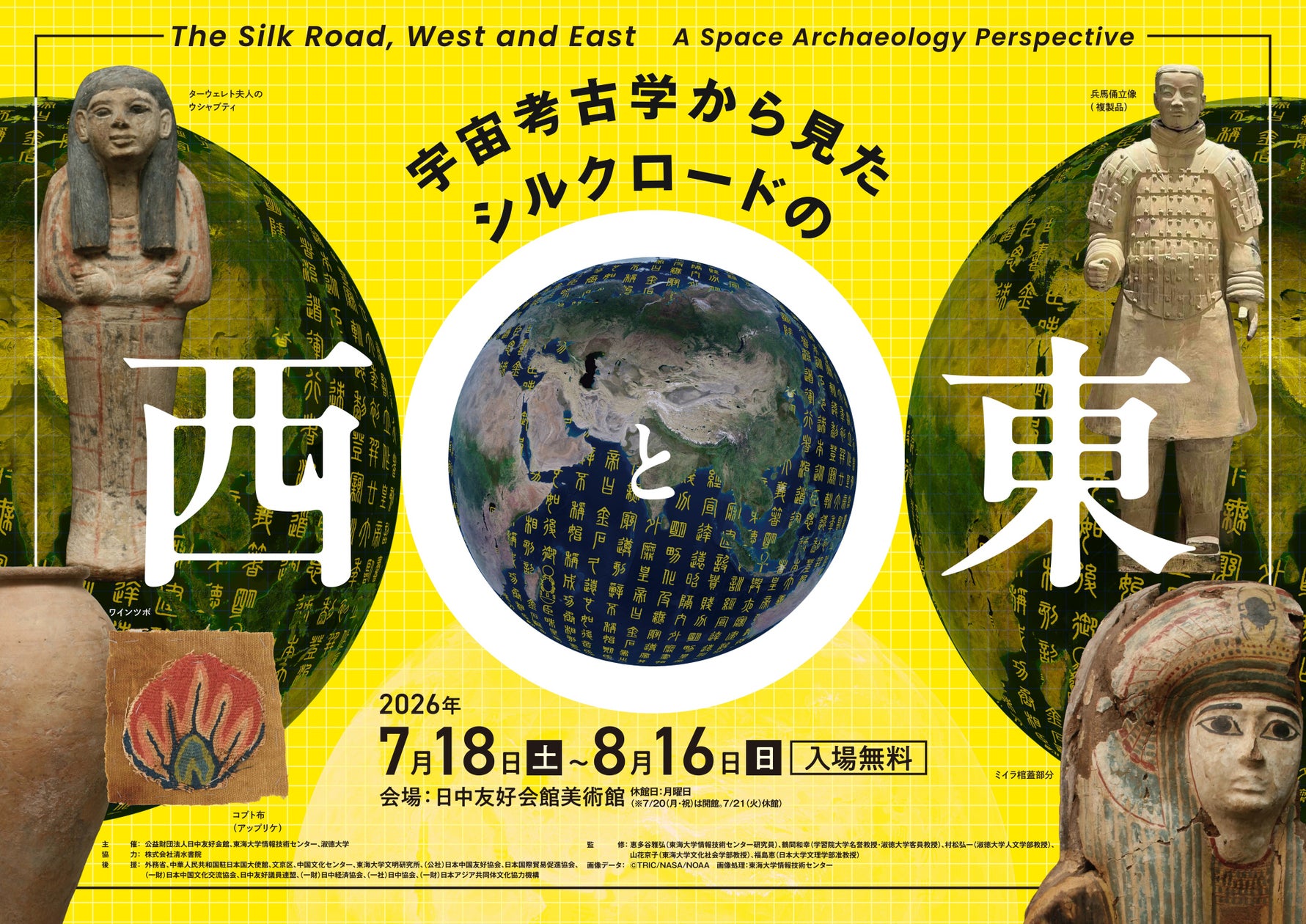
In the height of summer 2026, the Japan-China Friendship Center Art Museum will host the exhibition "The Silk Road East and West from the Perspective of Archaeogeology," which delves into the mysteries of ancient civilizations spread across the East and West of the Silk Road from a new perspective deciphered from space. Based on the latest research findings in archaeogeology, this exhibition will clearly introduce the little-known aspects of ancient civilizations revealed by satellite observations, blending storytelling and entertainment. Furthermore, through the display of ancient artifacts and their replicas that convey the conditions of the time, it will offer visitors an opportunity to broaden their knowledge and aesthetic interests, and to deepen their understanding of Chinese and Egyptian civilizations.
◎ Exhibition Overview
【Exhibition Name】
The Silk Road East and West from the Perspective of Archaeogeology
【Period】
July 18, 2026 (Sat) - August 16, 2026 (Sun)
【Organizers】
Japan-China Friendship Center, Tokai University Information Technology Center, Shukutoku University
【Cooperation】
Shimizushoin Co., Ltd.
【Sponsorship】
Ministry of Foreign Affairs, Embassy of the People's Republic of China in Japan, China Cultural Center, Japan-China Friendship Association, Japan Association for the Promotion of International Trade, Japan-China Cultural Exchange Association, Japan-China Parliamentary Friendship League, Japan-China Economic Association, Japan-China Association, Japan-Asia Community Cultural Cooperation Organization,
【Venue】
Japan-China Friendship Center Art Museum (1-5-3 Koraku, Bunkyo-ku, Tokyo)
【Opening Hours】
10:00 - 17:00
【Closed】
Mondays *Open on July 20 (Mon, holiday), closed on July 21 (Tue)
【Admission Fee】
Free
【Access】
- 1 minute walk from Exit C3 of Iidabashi Station on the Toei Oedo Line
- 7 minutes walk from the East Exit of Iidabashi Station on the JR Sobu Line
- 7 minutes walk from Exit A1 of Iidabashi Station on the Tokyo Metro Tozai Line, Yurakucho Line, and Namboku Line
【Exhibition URL】
https://jcfcmuseum.jp/events/event/2026-04/
◎ Exhibition Structure
Divided into 8 themes
Theme ❶: What is Archaeogeology?
Archaeogeology is the application of observation technologies from space to archaeology. It is an applied research field that understands the distribution of ruins and ancient environments from a broad and long-term perspective by integrating recent satellite imagery of the Earth with historical knowledge and archaeological materials.
Theme ❷: Exploring the Mausoleum of Qin Shi Huang
The mausoleum of Qin Shi Huang, who first unified China, remains to this day. Around it, 8,000 Terracotta Warriors were discovered, but the underground palace where Qin Shi Huang was buried has not yet been excavated. This section explores the mysteries of the underground palace using satellite imagery.
Theme ❸: Exploring the Space of the Qin Empire
The Qin Empire encompassed a vast territory. The length of the Great Wall, nearly 5,000 kilometers, signifies the empire's east-west extent. Centered on the capital Xianyang, Qin was conscious of north-south and east-west axes. This section verifies historical records of an eastern gate facing the sea using satellite imagery.
Theme ❹: Exploring Ancient Environments
It was discovered that an envoy was sent to Mount Kunlun in search of an elixir of immortality by Qin Shi Huang, and this was carved into a rock at the source of the Yellow River. Let's compare this western inscription with the inscriptions on Mount Tai and Langyatai in the east. The legend of Queen Mother of the West of Kunlun will also be explored through Han Dynasty stone reliefs.
Theme ❺: Overlooking the Silk Road from Satellites
A large-scale satellite image map, "Silk Road Satellite Map," was created by computer processing satellite and elevation data. Let's take an overhead view of the Silk Road through this 5-meter large image map, which overlays cities, ruins, and routes of the Silk Road on high-definition satellite imagery covering the area from Rome to Nara.
Theme ❻: Analysis of Satellite Imagery
For over 50 years since its establishment, the Tokai University Information Technology Center has played a leading role in image information engineering, including Earth observation from space, data analysis, and natural science research and development. This section introduces applied research and survey results of image information, including the archaeological application of satellite data, conducted at the Information Technology Center, through 4K video and other media.
Theme ❼: Discovery of Ancient Egyptian Ruins
The Tokai University Information Technology Center and the Waseda University Institute of Egyptology discovered ancient Egyptian ruins through satellite data and understanding of ancient environments. This is the first instance in the history of Egyptology where the location of ancient roads was identified using satellite data, leading to the discovery and excavation of ruins.
Theme ❽: Tokai University Egypt Collection
The Tokai University Collection of Egypt and the Near East (abbreviated as AENET) was donated by the bereaved family of the late Professor Hachiji Suzuki of Tokai University in 2010. Approximately 6,000 artifacts related to ancient Egypt and Islam, about 15,000 photographs and rubbings, and about 6,000 academic books are currently housed in the Tokai University Institute of Civilization and the Library. A portion of this collection will be exhibited.
◎ Special Exhibition
Valuable works selected from the collections of the Tokai University Egypt Collection and the Shukutoku University Center for Calligraphy and Cultural Studies will be exhibited.
Mummy coffin lid fragment, owned by the Tokai University Institute of Civilization Ushabti of Lady Taweret, owned by the Tokai University Institute of Civilization Coptic fabric (appliqué), owned by the Tokai University Institute of Civilization
Stone relief depicting the Queen Mother of the West, owned by the Shukutoku University Center for Calligraphy and Cultural Studies Mount Tai Inscription, owned by the Shukutoku University Center for Calligraphy and Cultural Studies Chinese ceramics (blue and white), owned by the Tokai University Institute of Civilization
◎ Related Events
Special Commemorative Lecture ❶: In Search of the Lost Han Dynasty "Silk Road" ~From Satellite Photos, Rock Carvings, and Inscriptions~
▸▸ Approximately 2,000 years ago, during the Han Dynasty. There was a transportation route connecting the East and West of the Eurasian continent, known as the "Silk Road." We will search for traces of this road, lost over long years and environmental changes, through satellite photos, rock carvings, and inscriptions exhibited in this exhibition.
【Date and Time】July 25 (Sat) 14:00 - 15:00
*Reception begins 1 hour before the start, doors open 30 minutes before. 【Venue】Japan-China Friendship Center B1 Floor, Grand Hall
【Lecturer】Koichi Muramatsu, Professor
▸ Professor, Department of History, Faculty of Humanities, Shukutoku University.
【Seating】100 seats (unreserved seating, advance reservation required)
【Participation Fee】Free *Advance reservation required
Click here to apply ↑
Special Commemorative Lecture ❷ Part 1: An Invitation to Archaeogeology
▸▸ Cutting-edge Earth observation satellite data is being utilized as an important tool for discovering ancient ruins and deciphering ancient history. "Archaeogeology" deciphers the ancient world through satellite data. We invite you to the world of archaeogeology.
【Date and Time】August 1 (Sat) 14:00 - 15:00
*Reception begins 1 hour before the start, doors open 30 minutes before.
【Venue】Japan-China Friendship Center B1 Floor, Grand Hall
【Lecturer】Masahiro Etani, Researcher
▸ Researcher, Tokai University Information Technology Center. Doctor of Engineering.
【Seating】100 seats (unreserved seating, advance reservation required)
【Participation Fee】Free *Advance reservation required
Special Commemorative Lecture ❷ Part 2: The Mausoleum of Qin Shi Huang as Seen from Satellite Imagery
▸▸ Exploring the ruins of the Qin Shi Huang era, who first unified China, from space. This presentation will introduce discoveries made in conjunction with historical documents, archaeological materials, and unearthed bamboo slip documents, including the Great Wall, the Mausoleum of Qin Shi Huang, and the Qin Shi Huang's envoy's inscription for collecting herbs.
【Date and Time】August 1 (Sat) 15:00 - 16:00
【Venue】Japan-China Friendship Center B1 Floor, Grand Hall
【Lecturer】Professor Kazuyuki Tsuruma
▸ Historian, Professor Emeritus, Gakushuin University.
【Seating】100 seats (unreserved seating, advance reservation required)
【Participation Fee】Free *Advance reservation required
Click here to apply ↑
For inquiries regarding this exhibition, please contact:
Japan-China Friendship Center, Cultural Projects Department
E-mail: bunka@jcfc.or.jp
Address: 1-5-3 Koraku, Bunkyo-ku, Tokyo
TEL: 03-3815-5085
URL: https://jcfcmuseum.jp/
FACT BOX
- Source: PR TIMES
- Category: 展覧会