Craftex Inc. (Headquarters: Shinjuku-ku, Tokyo; Representative Director: Shunpei Yamanaka) will begin offering "DataSyncer® AI-OCR to kintone," a new addition to its data integration service "DataSyncer® for kintone," which is compatible with kintone, a service developed by Cybozu, Inc., starting July 15, 2026.
This service is a cloud-based AI-OCR service that reads PDF documents such as order forms, invoices, and delivery slips according to the field configuration of kintone apps and automatically enters the data into fields as structured data usable in kintone. It eliminates the need for template definitions and mapping settings for each document, and can import documents with different layouts into a single kintone app.
Background: The Last Mile from Document PDFs to Structured Data
While AI-OCR technology has made it possible to read characters from document PDFs, the "last mile" of converting the read data into kintone records presented two challenges: 1) how to manage templates for each document, and 2) how to input the read data into kintone fields.
Template Management Becomes an Operational Burden: It was necessary to define templates for each document layout specifying "which item goes into which field." These templates had to be added each time a new business partner was added and recreated whenever their format changed. This template management cost continued to be an operational burden.
Disjointed Input into kintone: Traditional OCR required the read results to be exported to a file, such as a CSV, and then imported into kintone. The path to kintone was not a single, continuous one: "OCR → CSV Conversion → Registration in kintone."
Even though reading was possible, many sites continued manual data entry, foregoing automation due to the template management costs and the complexity of importing into kintone. How to cross the "last mile" after reading without manual effort? This was the final hurdle remaining for "documents x kintone."
What is "DataSyncer® AI-OCR to kintone"?
This service is a cloud-based AI-OCR service where AI optimized for kintone determines the content of document PDFs based on the app's field configuration (field types, choices, sub-tables, etc.) and automatically enters it into the appropriate fields. By having the AI understand the app configuration, i.e., recognize the business process, it solves the following two challenges:
Template Management → Unnecessary: There is no need to define document templates in advance. Simply by having kintone administrators design business apps as usual, the app configuration itself, created for each business unit (e.g., order management, billing management), becomes the standard for reading.
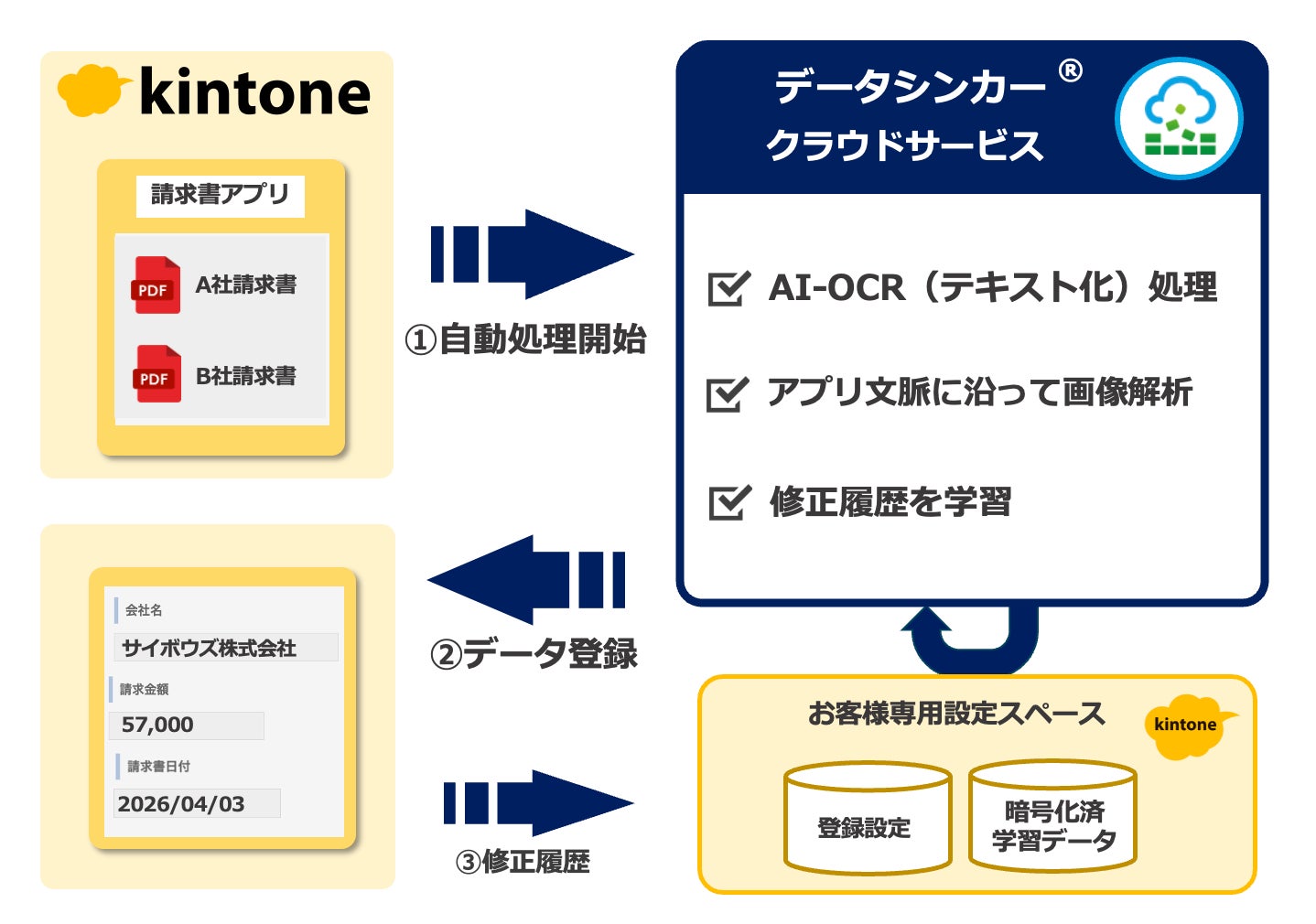
How to Input into kintone → Directly into Fields: The read content is directly entered into kintone fields by DataSyncer without intermediate output to CSV or other files. Simply attaching the PDF to the business app automatically registers the data in kintone as structured data that can be used for searching, aggregation, and notifications.
A Cloud-Based AI-OCR Service Optimized for kintone
This enables end-to-end processing from reading document PDFs to creating kintone records without manual template management or data entry.
Key Features
"DataSyncer® AI-OCR to kintone" is characterized by its simplicity in initial setup and daily operation, allowing the scope of AI involvement and the input flow to be adjusted to fit the specific needs of the site.
Different Layouts in a Single App
Documents with different layouts for each business partner can be imported into a single app organized by business unit. Variations in notation such as "Order Number," "Order No.," and "Purchase Order No." are absorbed by the AI and consolidated into the same field. Even if the number of documents increases, the number of managed apps remains one.
Absorbs Notation Variations and Registers in a Single Field
Secure Learning Loop
Corrections Go to a Secure Learning Loop
For documents from new business partners or suppliers, simply confirm and correct the first few entries within kintone. These corrections are reflected in subsequent readings of the same layout, reducing the effort of correction maintenance. The fields that AI should input into and those it should not can be specified according to operational needs.
Specify Fields for AI Input Based on Operations
AI only inputs data into fields that have been designated in advance. Fields that humans want to enter manually, such as representative names or approval status, or fields that are automatically calculated, can be excluded from AI processing and left as they are. This allows for separate operation of fields for AI input and fields for human input, ensuring peace of mind.
Input Pipelines Can Be Assembled According to Business Needs
Three types of input pipelines can be assembled to match the site's workflow. The service can be introduced without significantly altering existing business processes.
Standalone Mode: Attach PDF to kintone record from a browser.
Integrated PDF Mode: Combine with multifunction devices and scanners for direct registration to kintone ("DataSyncer® PDF to kintone").
Integrated Email Mode: Attached PDFs from incoming emails are directly registered to kintone ("DataSyncer® Mail to kintone").
Build Input Pipelines for PDF Documents According to Business Needs
With automatic import from email or multifunction devices, there is no need to perform the operation of attaching PDFs in a browser. Received documents are directly imported into kintone and undergo AI-OCR processing.
Furthermore, the mechanism that automatically processes when a PDF is attached to an app record ensures that PDFs attached to records via other input routes (such as form integration tools) also undergo the same AI-OCR processing.
Use Cases
Wholesale Industry: Order faxes from retailers into the order reception app: In the wholesale industry, where order forms with different layouts from each retailer are received via fax, multifunction devices can receive faxes and import them directly into kintone. The AI then inputs product codes, quantities, and desired delivery dates into the order management app, automating the order reception process that previously involved manual entry of a large volume of daily order faxes.
Manufacturing and Construction Industries: Process supplier invoices collectively at the end of the month: Invoice PDFs with different layouts from each supplier are received via email and imported collectively at the end of the month. The AI inputs invoice amounts, payment deadlines, and details into the payment management app, allowing staff to only review items requiring correction.
Manufacturing Industry: Transfer title blocks and parts lists from drawings to the drawing management app: In drawing PDFs, items to be structured, such as drawing numbers, product names, materials, quantities, and revisions, are consolidated in the title blocks and parts lists. The AI reads these and inputs them into the drawing management app, enabling search and management by drawing number and revision.
Security: For Your Peace of Mind
When having AI read documents, data handling is a concern. This service protects your information through the following mechanisms:
Not Used for AI Model Training: Your document data and correction history are not used for training the AI model. The AI infrastructure uses Amazon Bedrock, the same as Cybozu's "kintone AI."
Correction History Encrypted Per Company: Correction history is encrypted and stored in your dedicated space, not mixed with data from other companies. PDFs are processed only in memory and deleted immediately after processing.
Authentication Information Not Stored on Our Servers: API tokens are stored in a configuration app within kintone and retrieved from kintone for each process. No copies of authentication information are kept on our servers.
Pricing Plans
"DataSyncer® AI-OCR to kintone" is available for an initial fee of \100,000 and an annual usage fee of \120,000 (excluding tax for both). If you have already implemented a DataSyncer series product, the initial fee is free.
Annual Page Allocation: 5,000 pages (carry-over to the next year)
Additional Options: Additional processing pages (\50,000 / 2,000 pages)
A free trial is also available to test all features. Please visit the product page for details.
Endorsement from Cybozu, Inc.
Cybozu, Inc. sincerely welcomes the offering of "DataSyncer® AI-OCR to kintone," an AI service compatible with kintone from Craftex Inc. "DataSyncer® AI-OCR to kintone" can format data from document PDFs and register it as data optimized for kintone. We expect it to significantly reduce manual input and promote customer business improvements. We will continue to deepen our cooperative relationship to provide valuable support to our customers.
Kazuki Tamada, Executive Officer, Head of Sales Division, Cybozu, Inc.
Future Developments
This service aims not only to automate document input but also to make information previously buried in paper or PDFs searchable, aggregatable, and usable within kintone. Staff freed from manual input will be able to spend more time on tasks that only humans can do, such as confirmation and decision-making.
This will allow customers to collect document data into kintone not only through CSV, email, PDF, and app integration, but also through a new entry point: AI-OCR. Craftex Inc. will continue to develop products specializing in the "kintone x Data Integration" domain, aiming to create an environment where all data scattered within companies can be collected and utilized in kintone.
About Craftex Inc.
Company Name: Craftex Inc.
Location: Nishishinjuku Mizuma Building 6F, 3-3-13 Nishi-Shinjuku, Shinjuku-ku, Tokyo
Representative Director: Shunpei Yamanaka
Business Activities: Planning, development, and sales of kintone integration services
Main Services: DataSyncer for kintone, NEKOTA for kintone
Contact for Inquiries Regarding This Matter
Craftex Inc. info@craftex.co.jp
https://datasyncer.craftex.jp/
FACT BOX
- Source: PR TIMES
- Category: 製品リリース
- Organizations: Amazon Bedrock